Peugeot 208 Price, Specs & Features: Complete Buyer’s Guide 2026
The Peugeot 208 is one of Peugeot’s best-known compact hatchbacks, combining distinctive European styling with practical dimensions, modern technology and several powertrain choices. For buyers searching for a small car for commuting, city driving or everyday family use, the 208 deserves a closer look.
However, choosing the right version is not simply about finding the lowest Peugeot 208 price. The engine, trim level, equipment, fuel economy, boot space, safety technology and long-term running costs can all affect the ownership experience.
In this guide, we will look at the Peugeot 208 price, specifications, features, interior, engines, electric version, safety equipment and important buying considerations. Because prices and equipment can vary between countries, always check the local Peugeot website or dealer before making a final purchase.
Peugeot 208 Price: How Much Does It Cost?
The Peugeot 208 price depends on the country, trim level, engine, optional equipment, taxes and dealer promotions.
As a current UK reference, Peugeot’s online configurator lists the 208 from around £18,995 for the Turbo 100 petrol manual version. Hybrid versions are listed from approximately £22,845, while electric E-208 versions start from around £23,495, depending on the selected powertrain and specification.
These figures should be treated as a market reference rather than a worldwide Peugeot 208 price. In other countries, the final price can be substantially different because of taxes, import costs, incentives, exchange rates and local specifications.
Therefore, buyers should compare the on-the-road price rather than looking only at the advertised starting price.
For example, a more expensive trim may include technology or comfort equipment that would cost extra on an entry-level version. In some cases, spending slightly more initially can provide the features you actually want.
Peugeot 208 Overview
The Peugeot 208 is a compact five-door hatchback designed primarily for everyday driving.
Its relatively compact dimensions make it suitable for crowded urban roads, while its modern cabin and available driver-assistance technologies give it a more sophisticated feel than a basic city car.
The current 208 is approximately 4,055 mm long, 1,745 mm wide excluding mirrors and 1,430 mm high. Exact dimensions and equipment can vary by version.
One of its advantages is choice. Depending on the market, buyers can find the 208 with petrol, hybrid and fully electric powertrains.
That means the same basic model can appeal to different types of drivers.
A city commuter may prefer a petrol or hybrid version, while someone with convenient home or workplace charging may consider the E-208.
Peugeot 208 Engine and Powertrain Options
One of the most important decisions when buying a Peugeot 208 is selecting the right powertrain.
Current versions can include petrol, hybrid and electric options, although availability differs by market.
Peugeot 208 Petrol
The petrol version can make sense for buyers who want a conventional powertrain without needing access to an EV charging point.
The current UK configurator lists a Turbo 100 S&S manual version. It produces 100 PS and is paired with a six-speed manual transmission.
A petrol 208 can be particularly practical for drivers who regularly travel longer distances and want the flexibility of quickly refuelling at conventional fuel stations.
However, actual fuel consumption depends on traffic, driving style, road conditions, tyre pressure, weather and vehicle load.
Peugeot 208 Hybrid
The hybrid versions add an electrified element to the 208’s powertrain.
The UK range currently includes Hybrid 110 e-DSC6 and Hybrid 145 e-DSC6 options.
The hybrid system combines a petrol engine with electric assistance and a small battery. This can help improve efficiency, particularly during urban driving and situations involving frequent acceleration and deceleration.
For drivers who want some electrification without moving completely to a battery-electric vehicle, the hybrid can provide an interesting middle ground.
Nevertheless, buyers should compare the purchase price with expected fuel savings before deciding whether the additional cost makes sense for their driving pattern.
Peugeot E-208 Electric
The Peugeot E-208 is the fully electric version of the hatchback.
Current UK specifications include a 50 kWh battery with a 136 hp motor and a 51 kWh battery with a 156 hp motor, with the latter offering a claimed range of up to approximately 266.6 miles under the listed specification.
Official range figures are measured under test conditions. Real-world range can be lower because temperature, speed, traffic, driving style, road conditions, heating and air conditioning all affect energy consumption.
Consequently, buyers should consider their typical daily mileage rather than choosing an EV solely because of its headline range figure.
Peugeot 208 Performance and Driving Experience
The Peugeot 208 is designed primarily for everyday usability rather than extreme performance.
Its compact body makes it easy to manoeuvre in city traffic, while the available automatic and manual configurations give buyers different driving experiences.
The hybrid versions can provide smooth electric assistance during appropriate driving conditions. Meanwhile, the electric E-208 delivers the instant response associated with electric motors.
For urban drivers, the smaller footprint can be especially useful when parking or navigating narrow streets.
At the same time, buyers should take a proper test drive before purchasing. Seat position, steering feel, visibility and the layout of the Peugeot i-Cockpit can feel different from conventional hatchbacks.
Peugeot 208 Interior and Comfort
Inside, the 208 focuses heavily on modern design and technology.
Depending on the trim, buyers may find a digital instrument display, touchscreen infotainment, smartphone connectivity, climate controls, USB connectivity and other convenience features.
One of the most distinctive elements is Peugeot’s i-Cockpit concept, which combines a compact steering wheel with a digital driving display and centrally positioned infotainment screen.
The layout looks modern, but not every driver will have exactly the same preferred seating position.
Therefore, adjust the driver’s seat and steering wheel during your test drive. Make sure you can clearly see the instrument display without having to sit in an uncomfortable position.
That small check can make a significant difference to everyday satisfaction.
Peugeot 208 Technology and Infotainment
Modern buyers expect a small hatchback to provide more than basic transportation, and the 208 reflects that expectation.
Depending on the version, the vehicle can offer a 10-inch central touchscreen, Peugeot i-Connect or i-Connect Advanced, smartphone integration and connected navigation.
Wireless Apple CarPlay and Android Auto are available through the relevant infotainment system.
Higher specifications can add features such as connected navigation and voice recognition.
However, equipment varies by trim and market. Therefore, never assume that a feature shown in an advertisement is standard on every Peugeot 208.
Before ordering, compare the exact specification sheet for the vehicle you are buying.
Peugeot 208 Safety Features
Safety is another important consideration when choosing a small car.
Depending on specification and market, the Peugeot 208 can be equipped with technologies such as:
- Automatic Emergency Braking
- Lane Keeping Assist
- Lane Positioning Assist
- Blind Spot Monitoring
- Adaptive Cruise Control
- Driver Attention Alert
- Parking assistance
- Rear camera
- Parking sensors
- Electronic stability systems
- Multiple airbags
These technologies are designed to support the driver rather than replace careful driving.
Furthermore, safety equipment can differ between trim levels. Consequently, buyers should compare the exact standard and optional equipment before choosing a particular version.
Peugeot 208 Boot Space and Practicality
Although the Peugeot 208 is a small hatchback, it provides useful luggage capacity for everyday activities.
According to Peugeot’s current UK FAQ, petrol and hybrid versions offer up to 352 litres of boot space, while the E-208 provides around 309 litres. With the rear seats folded, capacity increases substantially.
This makes the 208 practical for shopping, commuting and shorter trips.
Nevertheless, if you regularly carry large items, travel with several passengers or need substantial luggage space, you should physically test the boot before purchasing.
A specification sheet can provide a number, but real-world usability also depends on the shape of the luggage area.
Peugeot 208 Fuel Economy and Running Costs
Fuel economy is one of the main factors buyers consider when researching the Peugeot 208.
The actual result depends on the powertrain and driving conditions.
Petrol models can be straightforward to refuel, while hybrid versions can reduce fuel consumption under suitable driving conditions. The E-208 removes petrol consumption altogether, although electricity and charging costs still need to be considered.
When calculating ownership costs, look beyond fuel or electricity.
Your total budget may also include:
- Insurance
- Servicing
- Tyres
- Registration and taxes
- Charging equipment
- Replacement parts
- Financing costs
- Depreciation
Therefore, the cheapest Peugeot 208 to buy is not automatically the cheapest one to own.
Peugeot 208 Reliability and Maintenance
Regular maintenance is essential for any vehicle.
Before buying a Peugeot 208, ask about the recommended service schedule, warranty coverage, roadside assistance and local availability of replacement parts.
For a used 208, the service history becomes particularly important.
Check whether scheduled maintenance was completed correctly and look for evidence of previous repairs. Also inspect the tyres, brakes, suspension, bodywork and electronic systems.
For an electric model, buyers should additionally understand the battery warranty and charging requirements.
A professional inspection is worthwhile when purchasing a used vehicle because it can identify problems that are difficult to spot during a short test drive.
Peugeot 208: New or Used?
A new Peugeot 208 provides the advantage of a factory warranty, current equipment and the ability to select the exact trim and powertrain.
On the other hand, a used 208 can provide a lower purchase price.
If you are considering a used model, do not focus only on mileage.
Check:
- Complete service history
- Previous accident damage
- Tyre condition
- Brake wear
- Engine performance
- Transmission operation
- Warning lights
- Air conditioning
- Infotainment system
- Parking sensors and cameras
- Electrical equipment
Additionally, compare several vehicles before deciding.
A slightly more expensive used car with strong maintenance records may be a different proposition from a cheaper example with an incomplete history.
Which Peugeot 208 Should You Buy?
There is no single version that is perfect for every buyer.
Instead, consider your daily driving pattern.
Choose Petrol If:
You want a conventional engine, frequently travel longer distances and do not have convenient access to EV charging.
Consider Hybrid If:
You spend significant time in urban traffic and want improved efficiency while keeping a petrol engine and familiar refuelling experience.
Consider the E-208 If:
You have reliable access to home or workplace charging and most of your daily journeys fit comfortably within the vehicle’s practical range.
Also compare trim levels carefully.
Sometimes the mid-range version provides the equipment you actually need without paying for every available option.
Peugeot 208: Important Buyer Tips
Before purchasing a Peugeot 208, follow a few simple steps.
First, calculate the complete ownership cost, not only the monthly finance payment.
Second, compare the exact specifications of each trim.
Third, take a proper test drive.
Fourth, check warranty and servicing costs.
Finally, if you are buying used, obtain a vehicle history report and consider an independent inspection.
These steps can help prevent an attractive advertised price from turning into an expensive ownership decision later.
Is the Peugeot 208 a Good Car for Buyers?
The Peugeot 208 offers a combination of compact dimensions, distinctive styling, modern technology and multiple powertrain choices.
Its biggest advantage for many buyers is flexibility. Instead of being limited to one type of engine, customers can choose between conventional petrol, hybrid and electric versions depending on market availability.
However, the right choice depends on your budget and lifestyle.
A petrol version may suit someone who prioritises straightforward long-distance refuelling. A hybrid can appeal to drivers seeking electrified efficiency without committing fully to an EV. Meanwhile, the E-208 can make sense for drivers with suitable charging access.
Ultimately, compare the price, equipment, powertrain, running costs and warranty rather than choosing a vehicle based only on appearance.
Final Verdict for Buyers
The Peugeot 208 is a compact hatchback that deserves consideration from buyers looking for modern styling, technology and a choice of powertrains.
Its price varies significantly by market and specification, so checking the exact local price is essential. More importantly, buyers should compare what they receive for the money.
Before making a final decision, test the car, compare trims, calculate running costs and check the warranty.
If you are researching other Peugeot vehicles, our broader Peugeot buying guide can help you understand the brand’s models, maintenance, safety, ownership costs and other important buying considerations.
A careful comparison today can help you choose a Peugeot 208 that fits your driving needs for years to come.
Frequently Asked Questions About Peugeot 208
1. How much does the Peugeot 208 cost?
The Peugeot 208 price varies by country, trim, engine and optional equipment. As a current UK reference, Peugeot’s online configurator lists the range from around £18,995 for the Turbo 100 petrol manual, while hybrid and electric versions cost more.
2. Is the Peugeot 208 available as an electric car?
Yes. The Peugeot E-208 is the fully electric version. Current UK specifications include 50 kWh and 51 kWh battery options, depending on the selected version.
3. What engines are available in the Peugeot 208?
Depending on the market, the Peugeot 208 is available with petrol, hybrid and electric powertrains. Exact engine and trim availability can change between countries and model years.
4. What is the Peugeot E-208 range?
The official claimed range depends on the battery and version. A current UK specification lists up to approximately 266.6 miles for the 51 kWh electric version. Real-world range can vary according to weather, speed, traffic, driving style and use of heating or air conditioning.
5. How much boot space does the Peugeot 208 have?
The petrol and hybrid versions can provide up to approximately 352 litres of boot capacity, while the E-208 has around 309 litres. Folding the rear seats increases available luggage space.
6. Is the Peugeot 208 good for city driving?
The compact dimensions of the 208 make it well suited to urban driving. Its size can make parking and manoeuvring easier, while available parking assistance and camera systems can add convenience.
7. Does the Peugeot 208 have Apple CarPlay and Android Auto?
Depending on the infotainment system and specification, the Peugeot 208 can offer wireless smartphone integration through Apple CarPlay and Android Auto.
8. Is the Peugeot 208 available with an automatic transmission?
Yes. Depending on the market and powertrain, automatic options include the e-DSC6 dual-clutch transmission on hybrid versions. Electric versions use an automatic transmission system.
9. Should I buy a petrol, hybrid or electric Peugeot 208?
The answer depends on your driving habits. Petrol can suit drivers wanting conventional refuelling, hybrid can suit those looking for electrified efficiency without depending entirely on charging, and the E-208 can suit drivers with convenient charging access.
10. What should I check before buying a used Peugeot 208?
Check the service history, accident history, tyres, brakes, suspension, engine or electric powertrain, transmission, infotainment, cameras, warning lights and overall body condition. An independent inspection can also be valuable before purchase
Internal links for PeugeotDrive
Your current website has the broader Peugeot buying guide, About Us and Contact pages, so I would not invent article URLs that don’t exist yet.
Use these natural anchor texts inside the article:
- “Peugeot buying guide” → PeugeotDrive Home / Buying Guide
- “learn more about PeugeotDrive” → About PeugeotDrive
- “contact PeugeotDrive” → Contact PeugeotDrive
SEO / fact-check notes
- Peugeot’s current UK configurator lists the 208 from £18,995, Hybrid 110 from £22,845, Hybrid 145 from £26,195, E-208 50 kWh 136 from £23,495, and E-208 51 kWh 156 from £24,295 at the time checked.
- Peugeot’s official FAQ currently states dimensions of 4,055 mm × 1,745 mm × 1,430 mm, with boot capacity varying by powertrain.
- The official FAQ also confirms the current 208 range includes Electric, Hybrid and Petrol versions, while equipment and trim availability are market-dependent.
- The article deliberately avoids claiming that one 208 version is universally “best”; the appropriate choice depends on the buyer’s usage, charging access and budget.
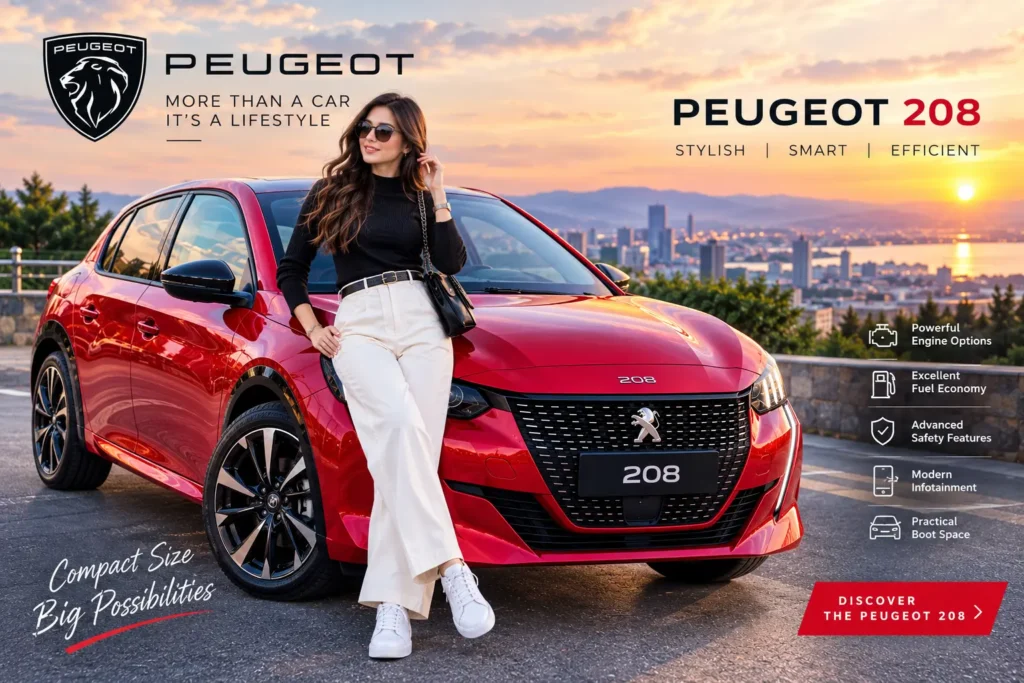
SEO tip: Is article ko publish karte waqt featured image ka ALT text rakho: “Red Peugeot 208 with modern features and stylish design”. This matches the article topic naturally without keyword stuffing.