Peugeot Car Models: Complete Guide to the Peugeot Range
Choosing a new car is rarely just about picking a brand. You also need to decide which body style, size, engine and equipment best fit your everyday life.
That is why understanding the different Peugeot car models is so important.
Peugeot has built a broad range covering small city cars, hatchbacks, SUVs, fastback-style cars and estate models. Depending on the model and market, buyers can also choose between petrol, hybrid, plug-in hybrid and fully electric powertrains.
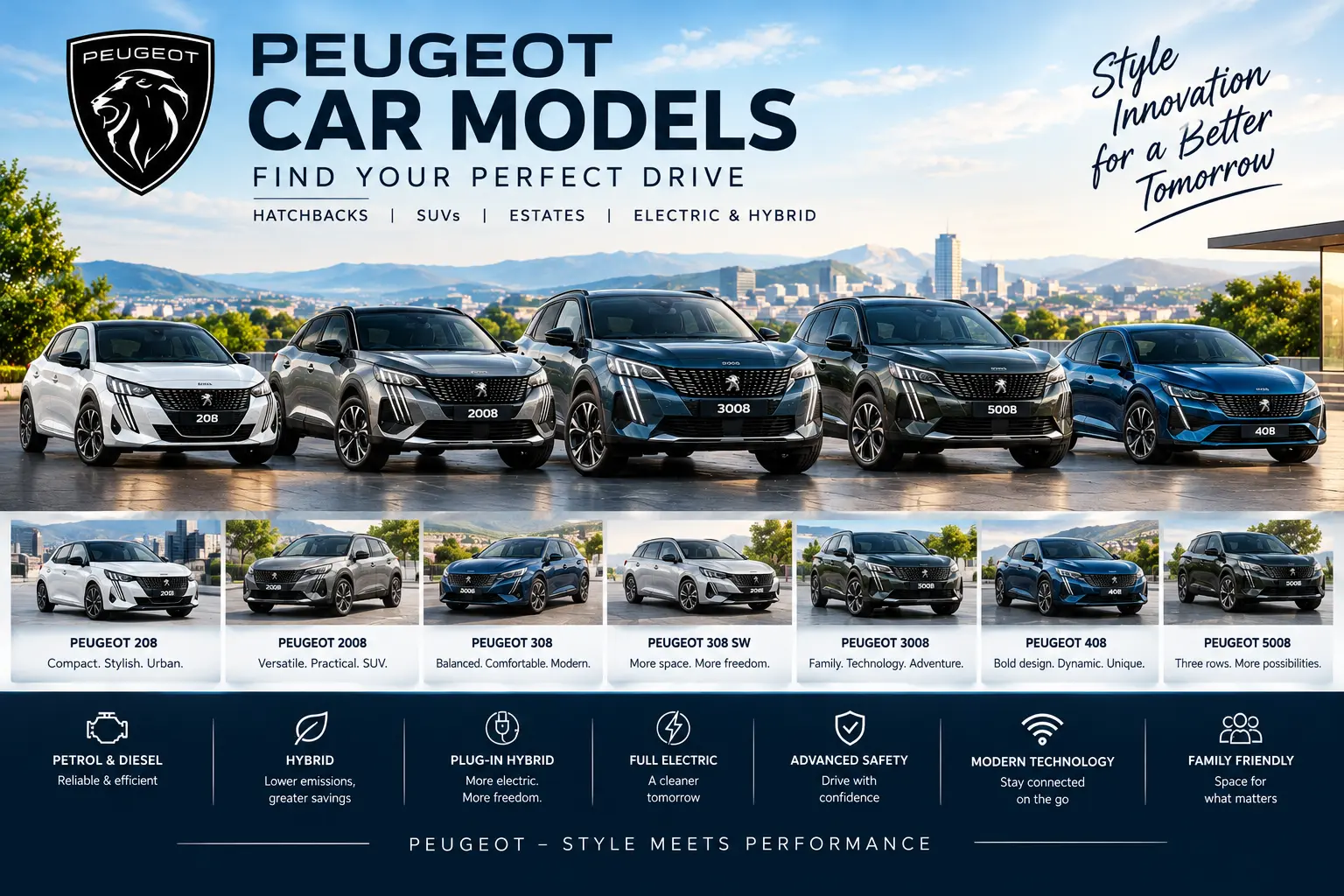
For example, the current Peugeot range includes the 208, 2008, 308, 308 SW, 3008, 408 and 5008, alongside electric versions of several models.
However, having plenty of choices can also make the buying process confusing.
Which Peugeot is best for city driving? Which one is better for a family? Is the 2008 more suitable than the 208? Should you choose a 3008 instead of a 5008?
This guide breaks down the main Peugeot models so you can understand what each one offers and choose the right car for your needs.
Peugeot Car Models at a Glance
| Peugeot Model | Body Style | Best For |
|---|---|---|
| Peugeot 208 | Small hatchback | City driving and commuting |
| Peugeot 2008 | Compact SUV | Small families and urban SUV buyers |
| Peugeot 308 | Hatchback | Everyday versatility |
| Peugeot 308 SW | Estate | Families and extra luggage |
| Peugeot 3008 | SUV/Fastback SUV | Family comfort and longer journeys |
| Peugeot 408 | Fastback | Style, space and distinctive design |
| Peugeot 5008 | Large SUV | Larger families and flexible seating |
The exact engines, trims and equipment can vary by country and model year. Therefore, always check the specification of the particular vehicle you are considering.
1. Peugeot 208: A Smart Small Car for Everyday Driving
The Peugeot 208 is one of the most recognisable models in the Peugeot range.
It is aimed at drivers who want a relatively compact car that is easy to use in busy urban environments while still offering modern styling and technology.
The 208 makes sense for commuters, couples, first-time buyers and small households.
Why choose the Peugeot 208?
Its compact dimensions are one of its biggest advantages.
Parking in busy areas can be stressful with a large vehicle. A smaller hatchback, however, is generally easier to manoeuvre through narrow streets and crowded car parks.
The 208 also has a distinctive exterior design and a modern cabin. Depending on specification and market, buyers can find petrol, hybrid and electric versions.
The electric E-208 is particularly interesting for drivers who want a small EV for daily commuting.
Peugeot currently lists the 208 with petrol, hybrid and electric options in the UK market.
Best for
- City commuters
- First-time buyers
- Couples
- Small households
- Drivers who prefer compact cars
- Buyers interested in small electric vehicles
If you want a detailed look at the model, explore our Peugeot 208 price, specifications and features guide on PeugeotDrive.
2. Peugeot 2008: Compact SUV with Everyday Versatility
If you like the Peugeot 208 but want a higher SUV-style driving position and additional practicality, the Peugeot 2008 is worth considering.
It sits above the 208 in terms of body style and provides a compact SUV alternative for buyers who do not need a large family vehicle.
The current 2008 is available with petrol, hybrid and fully electric powertrains in the UK.
What makes the Peugeot 2008 attractive?
First, the SUV shape gives it a different character from the 208.
It is still relatively manageable in urban areas, yet it offers the visual presence many buyers want from an SUV.
The interior also follows Peugeot’s modern design approach, with digital technology and connected features available depending on trim.
Furthermore, the choice of powertrains makes the 2008 more flexible for different types of buyers.
A petrol version may appeal to someone who wants conventional refuelling. A hybrid can suit buyers interested in electrification without moving completely to an EV, while the electric E-2008 can work for drivers with convenient charging access.
Best for
- Small families
- Urban SUV buyers
- Couples wanting extra practicality
- Drivers who prefer an elevated seating position
- Buyers considering an electric compact SUV
For a direct comparison, our Peugeot 2008 vs Renault Captur comparison is a useful next read.
3. Peugeot 308: A Versatile Hatchback
The Peugeot 308 occupies an important position in the range for buyers who want more space and versatility than a small hatchback but do not necessarily want an SUV.
It has a more conventional hatchback shape while still offering Peugeot’s modern styling and interior technology.
Why consider the Peugeot 308?
The 308 can work particularly well as an everyday family car or commuter vehicle.
It is also interesting because the current range offers different powertrain options, depending on market and specification. Peugeot UK currently lists electric, hybrid and diesel versions of the 308.
This variety allows buyers to focus on their actual driving habits.
For example, someone covering high annual mileage may evaluate powertrain options differently from a driver who mostly travels short distances around town.
What should buyers consider?
Do not choose a 308 solely because it looks attractive.
Take time to assess rear-seat space, boot practicality, driving position, infotainment usability and the exact equipment included with your preferred trim.
Best for
- Daily commuting
- Couples
- Small families
- Drivers who prefer hatchbacks
- Buyers who want more space than a city car
4. Peugeot 308 SW: The Practical Estate Choice
Some buyers want the practicality of a larger vehicle without switching to an SUV.
That is where the Peugeot 308 SW comes in.
The estate body style provides additional luggage-focused practicality while retaining the basic appeal of the 308.
Why choose the 308 SW?
The longer body can be useful for families, travellers and anyone who regularly carries luggage or equipment.
For example, an estate can make sense if you carry:
- Pushchairs
- Sports equipment
- Shopping
- Travel bags
- Work equipment
- Camping gear
The 308 SW is also offered with different powertrain choices depending on market. Peugeot’s current UK range lists electric, plug-in hybrid, hybrid, petrol and diesel versions.
Best for
- Families
- Frequent travellers
- Drivers who carry bulky luggage
- Estate-car fans
- Buyers who want practicality without a large SUV
5. Peugeot 3008: A Strong Family SUV
The Peugeot 3008 is one of the most important models in the Peugeot SUV range.
It is larger and more family-focused than the 2008, making it particularly appealing to buyers who regularly carry passengers or travel longer distances.
The current 3008 is available with electric and hybrid options in the UK.
Why is the Peugeot 3008 popular?
One of its biggest strengths is balance.
It offers the practicality of an SUV without moving all the way into the largest vehicle category.
The cabin provides a modern environment, while the exterior gives the vehicle a more substantial road presence.
The 3008 is also interesting for buyers considering electrification.
A hybrid can provide an alternative to a conventional petrol setup, while an electric E-3008 is designed for buyers who want to make the move to fully electric SUV ownership.
Who should buy the Peugeot 3008?
It is worth considering if you:
- Have a growing family
- Regularly travel on motorways
- Want more space than a 2008
- Prefer SUV styling
- Want hybrid or electric options
- Need a comfortable long-distance vehicle
If you are comparing family SUVs, read our Peugeot 3008 vs Nissan Qashqai comparison for another useful perspective.
6. Peugeot 408: A Stylish Alternative to Traditional Cars
The Peugeot 408 is one of the more distinctive Peugeot car models.
Rather than following the traditional hatchback or SUV formula, it uses a fastback-style design that aims to combine sleek styling with practical everyday usability.
This makes it attractive to buyers who want something visually different.
What makes the Peugeot 408 different?
The 408 can appeal to drivers who like the driving experience and lower profile of a passenger car but also appreciate the design language associated with modern crossover vehicles.
Depending on market and specification, Peugeot offers the 408 with hybrid and electric powertrain options.
Who should consider it?
The 408 is particularly suitable for buyers who prioritise:
- Distinctive styling
- A modern interior
- Long-distance comfort
- Hybrid or electric choices
- A less conventional alternative to an SUV
It may not be the obvious choice for every family, but that is part of its appeal.
7. Peugeot 5008: Designed for Larger Families
When passenger space becomes the main priority, the Peugeot 5008 deserves attention.
It is the larger SUV option in Peugeot’s mainstream passenger range and is designed around family flexibility.
The current 5008 is available with hybrid and electric options in the UK.
Why choose the Peugeot 5008?
The biggest advantage is flexibility.
Families often need more than just a large boot. They may need additional seating, storage options and the ability to change the cabin layout depending on the journey.
That makes the 5008 particularly interesting for larger households.
However, buyers should always check the exact seating configuration and luggage requirements of the vehicle they are considering.
Best for
- Large families
- Frequent group travel
- Buyers needing additional seating flexibility
- Family holidays
- Drivers who need a larger SUV
If three-row practicality is important, compare the 5008 with similarly sized family SUVs before making your final decision.
Peugeot SUVs vs Hatchbacks: Which Is Right for You?
One of the first decisions you should make is whether you actually need an SUV.
SUVs such as the 2008, 3008 and 5008 can offer a higher seating position and a more substantial body style.
However, hatchbacks such as the 208 and 308 can be easier to manoeuvre and may suit buyers who do not require the additional height and size of an SUV.
Choose a Peugeot hatchback if:
- You mostly drive in cities.
- Parking space is limited.
- You want a smaller vehicle.
- You prefer a lower driving position.
- You do not regularly carry large loads.
Choose a Peugeot SUV if:
- You prefer a higher seating position.
- You regularly carry passengers.
- You need flexible luggage space.
- You want SUV styling.
- You frequently travel with family.
There is no universally better body style. The right choice depends on how you actually use your car.
Petrol, Hybrid or Electric: Which Peugeot Powertrain Is Best?
Modern Peugeot car models give buyers more than one approach to powering their vehicle.
Petrol
Petrol remains a straightforward option for drivers who prefer conventional refuelling.
It can also be useful in areas where charging infrastructure is limited.
Hybrid
Peugeot’s current hybrid range combines petrol and electric power. The manufacturer positions its hybrid technology as a solution for both shorter everyday trips and longer journeys.
A hybrid may be particularly attractive to buyers who want some electrification without depending on external charging.
Plug-In Hybrid
A plug-in hybrid can provide electric driving for suitable shorter journeys while retaining a combustion engine for longer trips.
However, regular charging is important if you want to make the most of the electric side of the system.
Electric
Peugeot offers electric versions of several models, including the E-208, E-2008, E-308, E-3008 and E-5008 in the current UK range.
Electric cars can be particularly convenient for drivers who can charge at home or at work.
However, buyers should consider charging availability, electricity costs, long-distance travel requirements and real-world range before making the switch.
Which Peugeot Model Is Best for City Driving?
For urban driving, the Peugeot 208 is one of the easiest models in the range to shortlist.
Its compact format makes it practical for busy streets and parking spaces.
The 2008 is another option if you prefer an SUV-style vehicle.
Therefore:
Best small city car: Peugeot 208
Best compact city SUV: Peugeot 2008
Which Peugeot Is Best for Families?
For smaller families, the 2008 or 308 can be sufficient.
use For growing families, the 3008 offers a stronger combination of passenger space and SUV practicality.
For larger families, the 5008 is the model to investigate first.
A simple guide is:
- Small family: 2008 or 308
- Growing family: 3008
- Large family: 5008
- Extra luggage: 308 SW
Of course, family needs vary, so always test the actual rear-seat and boot space before buying.
Which Peugeot Is Best for Electric Car Buyers?
If you want a Peugeot EV, the right model depends mainly on size and driving requirements.
The E-208 is the compact option.
The E-2008 adds SUV practicality.
The E-308 provides a larger hatchback alternative.
The E-3008 is aimed at buyers wanting an electric SUV.
Meanwhile, the E-5008 targets larger families looking for an electric SUV with greater passenger flexibility.
Peugeot’s current model range confirms that electric options are now spread across several parts of its passenger-car lineup.
How to Choose the Right Peugeot Car Model
Buying the right Peugeot is easier if you start with your lifestyle instead of starting with a particular model.
1. Set your budget
Consider the purchase price, finance costs, insurance, fuel or electricity, servicing and tyres.
2. Think about your typical journeys
Do you drive mainly in town or spend hours on motorways?
Your answer can influence which engine and body style make the most sense.
3. Decide how much space you need
Do not buy a large SUV simply because it looks impressive.
If two people normally travel in the car, a 5008 may provide more space than you actually need.
4. Choose the right powertrain
Consider petrol, hybrid, plug-in hybrid or electric according to your driving pattern and charging access.
5. Compare trims
Two vehicles with the same model name can have very different equipment depending on trim.
Check safety features, infotainment, parking technology, seats, wheels and other important equipment.
6. Take a test drive
A test drive is essential.
Check the driving position, visibility, steering, ride comfort, cabin noise, infotainment controls and rear-seat space.
7. Think about ownership
The cheapest car to buy is not always the cheapest car to own.
Insurance, servicing, tyres, fuel, electricity and depreciation can all influence the real cost.
Peugeot Car Models: Which One Should You Buy?
There is no single Peugeot that is perfect for every driver.
Instead, each model has a particular role.
The Peugeot 208 is a strong choice for compact urban driving.
The Peugeot 2008 makes sense for buyers who want a small SUV.
Also, The Peugeot 308 offers a balanced hatchback alternative.
The 308 SW adds useful estate-car practicality.
The 3008 is a compelling option for families who want a larger SUV.
The 408 stands out for buyers who want something more distinctive.
Finally, the 5008 is designed for households that need greater passenger flexibility.
Peugeot’s current range also gives buyers more choice between petrol, hybrid, plug-in hybrid and electric powertrains, although the exact combinations depend on the model and market.
Final Verdict
The best Peugeot car model is ultimately the one that fits your lifestyle rather than the one with the longest equipment list.
If you spend most of your time in the city, start with the 208 or 2008.
If you want a versatile family car, look closely at the 308 or 3008.
Also, if you carry a lot of luggage, the 308 SW deserves consideration.
If you want distinctive styling, the 408 offers something different.
And if you regularly carry a large family, the 5008 should be high on your shortlist.
Before making your final decision, compare the exact specification, running costs, finance terms, warranty and local availability. Most importantly, take the vehicle for a proper test drive.
A Peugeot may look perfect on a specification sheet, but the best model is the one that feels right when you actually live with it.
10 Frequently Asked Questions About Peugeot Car Models
1. How many Peugeot car models are available?
The Peugeot range includes several passenger-car models such as the 208, 2008, 308, 308 SW, 3008, 408 and 5008. Availability varies by country and model year.
2. Which Peugeot model is best for city driving?
The Peugeot 208 is a strong choice for city driving because of its compact hatchback format. If you prefer an SUV, the Peugeot 2008 is worth considering.
3. Which Peugeot is best for a family?
The Peugeot 3008 is a good option for many families because it offers a larger SUV format. Larger households should also consider the Peugeot 5008.
4. Is the Peugeot 2008 a good SUV?
Yes. The 2008 provides a compact SUV alternative with modern styling, technology and different powertrain choices depending on the market.
5. What is the difference between the Peugeot 208 and 2008?
The 208 is a small hatchback, while the 2008 is a compact SUV. The 2008 offers a higher SUV-style body and is aimed at buyers wanting additional versatility.
6. Is the Peugeot 3008 bigger than the 2008?
Yes. The 3008 occupies a larger position in Peugeot’s SUV range and is generally more suitable for buyers who need additional passenger and luggage space.
7. Is the Peugeot 5008 a seven-seater?
The 5008 is designed around flexible family seating, with seven-seat configurations available depending on version and market. Always check the exact specification of the vehicle you are buying.
8. Which Peugeot models are electric?
Current Peugeot electric models include the E-208, E-2008, E-308, E-3008 and E-5008 in the UK range. Availability varies between markets.
9. Are Peugeot cars available as hybrids?
Yes. Peugeot currently offers hybrid versions of several models, including the 208, 2008, 308, 308 SW, 3008 and 5008 in the UK.
10. How do I choose the right Peugeot model?
Start with your budget, driving habits, passenger requirements and preferred powertrain. Then compare equipment, running costs and practicality before taking your shortlisted models for a test drive.