Peugeot 208 vs Renault Clio: Which Small Hatchback Is Better?
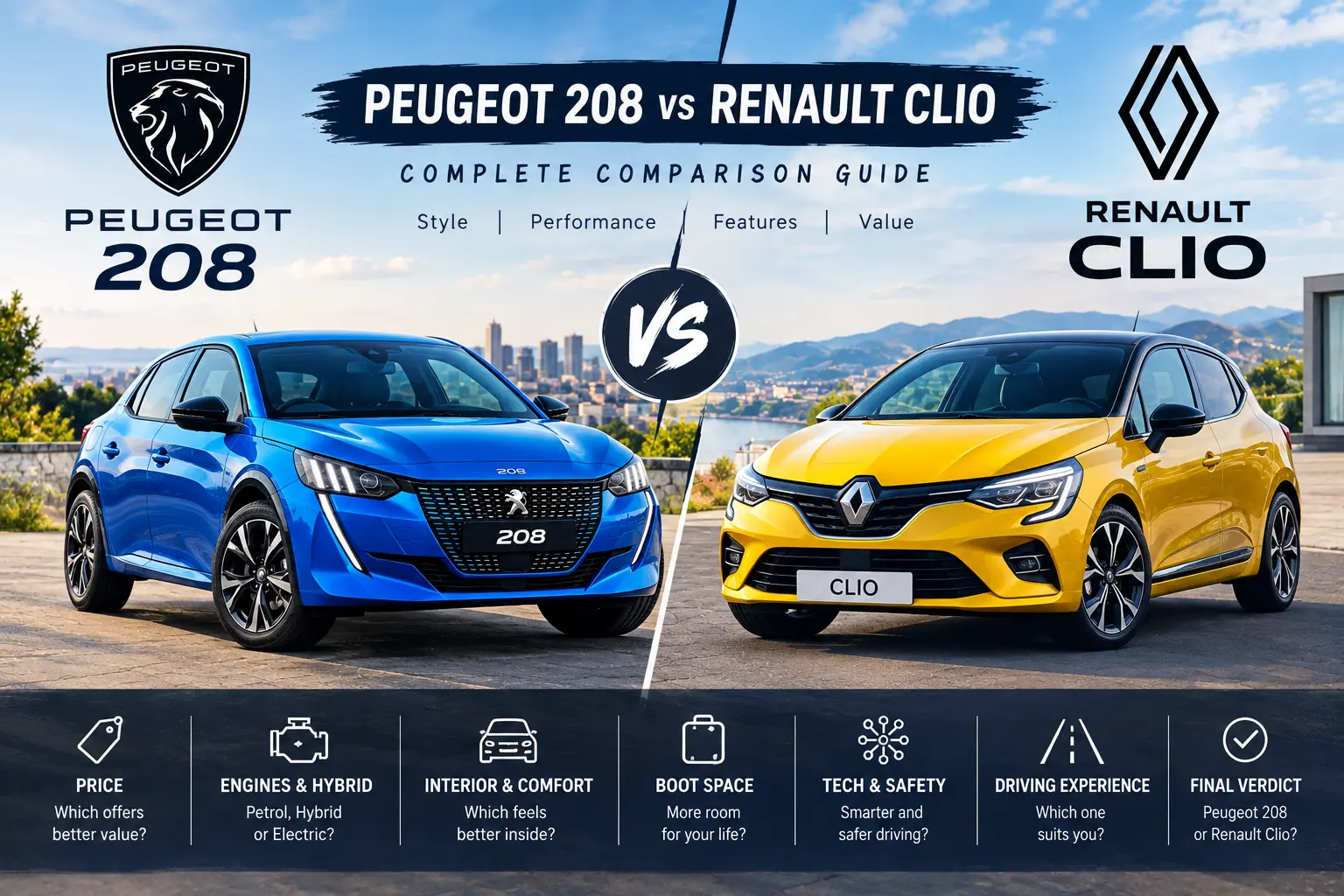
The Peugeot 208 vs Renault Clio comparison is an important one for anyone looking for a stylish, practical and efficient small hatchback. Both cars are designed for everyday driving, especially in cities, while also offering enough comfort and technology for longer journeys.
However, choosing between them is not simply a matter of picking the car with the lowest price. Engine choice, fuel economy, interior design, boot space, technology, safety equipment and ownership costs can all influence which car makes more sense for you.
The Peugeot 208 stands out with its distinctive styling, Peugeot i-Cockpit interior and a broad choice of petrol, hybrid and electric powertrains in markets where those versions are available. The Renault Clio, meanwhile, offers a practical cabin, strong hybrid technology and a comfortable everyday driving experience.
So, Peugeot 208 or Renault Clio? The answer depends on what you expect from your next car.
Peugeot 208 vs Renault Clio: Quick Comparison
| Feature | Peugeot 208 | Renault Clio |
|---|---|---|
| Body style | 5-door hatchback | 5-door hatchback |
| Main focus | Style, technology and powertrain choice | Practicality, efficiency and comfort |
| Petrol option | Available | Available |
| Hybrid option | Available in selected markets | Full hybrid E-Tech available |
| Fully electric version | E-208 available | Current Clio is not a full EV |
| Automatic option | Available depending on powertrain | Available with E-Tech hybrid |
| Boot space | Up to 352 L petrol/hybrid; 309 L E-208 | Up to 391 L petrol; hybrid capacity differs |
| Infotainment | Peugeot i-Cockpit and touchscreen technology | Easy Link/modern connected technology depending on version |
| Best suited to | City drivers wanting style and powertrain choice | Buyers prioritising practicality and hybrid efficiency |
Specifications and equipment can vary according to country, trim and model year, so buyers should always check the exact local version before ordering.
Peugeot 208 vs Renault Clio: Design and Styling
When it comes to exterior design, both hatchbacks take a modern approach, but their personalities are quite different.
The Peugeot 208 has a bold and distinctive appearance. Its front-end design, sharp lighting signature and sculpted bodywork give it a sporty character. As a result, it can appeal strongly to buyers who want a small car that looks more premium and expressive.
The Renault Clio, on the other hand, follows a more rounded and sophisticated design philosophy. Its compact proportions make it suitable for urban environments, while the exterior still provides a modern European appearance.
Therefore, styling is largely a matter of personal preference.
If you want a hatchback that looks particularly dramatic and technology-focused, the Peugeot 208 may be more attractive. Conversely, if you prefer a more understated but modern design, the Clio could be the better fit.
Peugeot 208 vs Renault Clio: Engine and Powertrain Choices
Powertrain choice is one of the biggest differences between these two cars.
The current Peugeot 208 range in the UK includes petrol, self-charging hybrid and fully electric versions. Peugeot’s current UK information lists a Turbo 100 petrol model, Hybrid 110 and Hybrid 145 versions, plus E-208 electric versions.
The Renault Clio is also available with petrol and full-hybrid technology. Current UK specifications include a TCe 90 petrol model and an E-Tech full hybrid producing 145 hp.
Peugeot 208 Petrol
The petrol 208 can be a straightforward choice for drivers who want conventional refuelling and do not have access to home charging.
The current UK version uses a 100 PS Turbo petrol engine with a six-speed manual gearbox.
For drivers who frequently travel outside cities, this configuration can be appealing because refuelling is quick and widely available.
Peugeot 208 Hybrid
The Peugeot 208 Hybrid is particularly interesting for urban drivers.
Hybrid technology combines a petrol engine with electric assistance. Consequently, it can help reduce fuel consumption during suitable driving conditions, especially in traffic where frequent acceleration and braking occur.
The current UK range includes Hybrid 110 and Hybrid 145 versions with automatic transmission.
Peugeot E-208
The E-208 gives Peugeot an important advantage in this comparison because buyers who want a fully electric small hatchback have an option within the 208 range.
Current UK specifications include 50 kWh and 51 kWh battery options, with power outputs of 136 hp and 156 hp respectively.
However, an electric car makes the most sense when you have convenient charging at home, work or nearby public charging locations.
Renault Clio E-Tech Hybrid
The Renault Clio’s E-Tech full hybrid is one of its major selling points.
The current UK specification uses a 145 hp full-hybrid powertrain with an automatic transmission. Renault quotes combined fuel consumption of up to 65.7 mpg for the current specification.
Because the Clio hybrid does not require external charging, it can be attractive to buyers who want electrification without changing their normal refuelling routine.
Powertrain winner: It depends on your needs. The Peugeot 208 wins for variety, particularly because of its fully electric E-208. The Clio is highly competitive for buyers specifically interested in a self-charging hybrid hatchback.
Peugeot 208 vs Renault Clio: Interior and Comfort
Inside, these cars take noticeably different approaches.
The Peugeot 208 uses the brand’s i-Cockpit concept. A compact steering wheel sits below a digital instrument display, while the central touchscreen handles infotainment and other functions.
This design gives the 208 a modern and distinctive cabin.
However, the driving position is personal. Some drivers immediately like the compact steering wheel and instrument layout, while others may prefer a more conventional dashboard arrangement.
For that reason, a proper test drive is particularly important.
The Renault Clio focuses more strongly on straightforward everyday usability. Depending on trim, buyers can get a digital driver’s display, touchscreen infotainment, smartphone connectivity and additional comfort features.
Moreover, the Clio’s interior packaging gives it a practical character that suits families and daily commuters.
Interior winner: The Peugeot 208 has the more distinctive and driver-focused design, while the Clio offers a practical and easy-to-live-with cabin.
Peugeot 208 vs Renault Clio: Technology and Infotainment
Technology is now an important part of even small hatchbacks.
The Peugeot 208 can be equipped with a 10-inch central touchscreen, Peugeot i-Connect technology, smartphone connectivity and connected navigation depending on specification.
Wireless Apple CarPlay and Android Auto are also available on relevant versions.
The Renault Clio can also provide modern touchscreen technology, smartphone integration, navigation and connected services depending on trim.
Therefore, neither car is outdated when it comes to everyday connectivity.
Nevertheless, the user experience is different.
The Peugeot’s i-Cockpit gives the dashboard a more futuristic appearance, while Renault’s approach can feel more conventional and practical.
Before buying either vehicle, check the exact equipment list because features can differ considerably between trims.
Peugeot 208 vs Renault Clio: Boot Space and Practicality
Practicality is where the Renault Clio deserves serious consideration.
The current Renault information lists up to 391 litres of boot space for the petrol TCe 90, while the full-hybrid version has a different luggage capacity because of its powertrain packaging.
The Peugeot 208 offers up to 352 litres for petrol and hybrid versions. The electric E-208 has approximately 309 litres.
Consequently, the Clio can have an advantage if luggage capacity is one of your main priorities.
For everyday shopping, school runs and commuting, both cars can be practical. However, families should physically test the rear seats and boot with their own luggage, child seats or other equipment.
Numbers on a specification sheet are useful, but real-world usability matters more.
Practicality winner: Renault Clio, particularly for buyers who prioritise luggage space and everyday versatility.
Peugeot 208 vs Renault Clio: Fuel Economy
Fuel economy depends heavily on the engine, transmission, driving style and road conditions.
The Peugeot 208 Hybrid can be particularly useful for urban driving because the electric assistance can reduce the amount of work required from the petrol engine in appropriate conditions.
The Renault Clio E-Tech hybrid is also designed around efficient urban driving. Renault’s current UK specification quotes up to 65.7 mpg combined for the 145 hp full hybrid.
However, official WLTP figures should not be treated as guaranteed real-world consumption.
Traffic, weather, tyre pressures, driving style, passenger load and use of heating or air conditioning can all influence actual fuel consumption.
For this reason, compare official figures as a useful reference rather than a promise.
Efficiency winner: The Renault Clio E-Tech is a strong choice for hybrid-focused buyers, while the Peugeot 208 provides more flexibility because it also offers petrol and fully electric alternatives.
Peugeot 208 vs Renault Clio: Safety Features
Safety should always be considered alongside styling and performance.
Depending on specification, the Peugeot 208 can offer features such as:
- Automatic Emergency Braking
- Lane Keeping Assist
- Driver Attention Alert
- Blind Spot Monitoring
- Adaptive Cruise Control
- Parking assistance
- Parking sensors
- Reversing camera
- Multiple airbags
- Electronic stability systems
The Renault Clio can also offer a broad range of driver-assistance technologies, including automatic emergency braking, lane assistance, traffic-sign recognition, parking assistance and driver-monitoring functions depending on version.
However, equipment varies by trim and market.
Therefore, do not assume that the most advanced feature shown in an advertisement comes as standard on every model.
Safety winner: Too close to call without specifying exact trims. Compare the safety equipment fitted to the two versions you are actually considering.
Peugeot 208 vs Renault Clio: Price and Value
Price is one of the first things buyers search for, but advertised starting prices can be misleading.
As a current UK reference, Peugeot’s online configurator lists the 208 from around £18,995 for the Turbo 100 petrol manual. Hybrid and electric versions cost more.
Renault’s current UK page lists the Clio from around £20,995, with the full-hybrid E-Tech version starting higher.
These figures are UK market references only. Prices can change because of promotions, taxes, specifications, dealer offers and model-year updates.
More importantly, compare what you receive for the money.
A cheaper car may become less attractive if you need to spend considerably more on optional equipment. Conversely, paying slightly more for a better-equipped trim could make sense if those features are important to you.
Therefore, compare:
- Purchase price
- Monthly finance cost
- Insurance
- Fuel or electricity
- Servicing
- Tyres
- Warranty
- Depreciation
- Optional equipment
Value winner: There is no universal winner. Compare equivalent trims and powertrains in your local market.
Peugeot 208 vs Renault Clio: Which Is Better for City Driving?
Both cars are well suited to city driving because they are compact hatchbacks.
The Peugeot 208’s relatively small footprint makes parking and manoeuvring easier. Its hybrid version can also be attractive for urban commuters who want improved efficiency without moving completely to an EV.
The Renault Clio is similarly well suited to urban environments. Its hybrid powertrain makes it particularly interesting for drivers who spend a lot of time in traffic.
If you have access to reliable home charging, however, the E-208 becomes an additional option.
For city driving: The Peugeot 208 is an excellent choice for buyers wanting powertrain variety, while the Clio is especially compelling for buyers who want a fuel-efficient hybrid.
Peugeot 208 vs Renault Clio: Which One Should You Buy?
So, which is better: Peugeot 208 or Renault Clio?
The answer depends on your priorities.
Choose the Peugeot 208 if:
- You prefer distinctive styling.
- You like the Peugeot i-Cockpit design.
- You want petrol, hybrid or electric options.
- You are considering a fully electric hatchback.
- You want a compact car with modern technology.
- You prefer a more distinctive interior.
Choose the Renault Clio if:
- Boot space is particularly important.
- You want a self-charging full hybrid.
- You prefer a practical cabin layout.
- You want a compact family-friendly hatchback.
- You want strong fuel-efficiency potential from a hybrid system.
- You prefer Renault’s interior and driving environment.
Ultimately, neither car is automatically better for every driver.
Your annual mileage, typical journeys, charging access, passenger requirements and budget should determine your choice.
Peugeot 208 vs Renault Clio: Final Verdict
The Peugeot 208 vs Renault Clio comparison is closer than it may initially appear.
The Peugeot 208 stands out because of its striking design, distinctive i-Cockpit interior and wide powertrain selection. Most importantly, buyers can choose between petrol, hybrid and fully electric versions where available.
The Renault Clio counters with excellent practicality, a useful boot, comfortable everyday characteristics and a strong full-hybrid option.
Therefore, the Peugeot 208 is the better choice for buyers who prioritise styling, technology and powertrain variety, while the Renault Clio is particularly appealing to buyers who prioritise practicality and hybrid efficiency.
Before making a final decision, test drive both cars back-to-back. Adjust the seats, check rear passenger space, test the infotainment, inspect the boot and compare the exact prices and equipment of equivalent versions.
If you are continuing your Peugeot research, our Peugeot 208 buyer’s guide provides more detailed information about the 208’s engines, features, boot space, running costs and buying considerations. You can also read our broader Peugeot cars guide for information about other models and powertrain choices.
The best small hatchback is ultimately the one that fits your everyday life—not simply the one with the longest equipment list.
10 Frequently Asked Questions
1. Is the Peugeot 208 better than the Renault Clio?
Neither car is universally better. The Peugeot 208 is particularly attractive for buyers who want distinctive styling and petrol, hybrid or electric powertrain choices. The Renault Clio can be more appealing to buyers who prioritise practicality and full-hybrid efficiency.
2. Which is cheaper, Peugeot 208 or Renault Clio?
Prices vary by country, trim and engine. Current UK manufacturer pricing places the entry-level Peugeot 208 below the current Clio starting price, although equivalent hybrid or higher-spec versions can change the comparison.
3. Which has better boot space, Peugeot 208 or Renault Clio?
The Renault Clio generally has an advantage in petrol form, with up to 391 litres listed by Renault. The Peugeot 208 offers up to 352 litres for petrol and hybrid versions, while the E-208 provides around 309 litres.
4. Is the Peugeot 208 available as a hybrid?
Yes. The Peugeot 208 is available with self-charging hybrid powertrains in markets where those versions are offered. Current UK versions include Hybrid 110 and Hybrid 145 options.
5. Is the Renault Clio available as a hybrid?
Yes. The current Renault Clio is available with the E-Tech full-hybrid powertrain. The current UK specification produces 145 hp and uses an automatic transmission.
6. Which car is better for city driving?
Both are suitable for city driving. The Peugeot 208 benefits from compact dimensions and multiple powertrain options, while the Renault Clio E-Tech is particularly interesting for drivers who spend considerable time in urban traffic.
7. Which has better technology?
Both cars offer modern technology. The Peugeot 208 stands out with its i-Cockpit concept, digital displays and touchscreen technology. The Clio also offers digital displays, smartphone connectivity and modern infotainment depending on trim.
8. Is the Peugeot 208 fully electric?
Yes. The E-208 is the fully electric version of the Peugeot 208. Current UK specifications include different battery and motor configurations, depending on the version.
9. Which is better for a small family?
Both can work well for a small family. The Renault Clio can have an advantage in boot practicality, while the Peugeot 208 offers a broad choice of powertrains and a technology-focused cabin.
10. Should I buy a Peugeot 208 or Renault Clio?
Choose the Peugeot 208 if styling, technology and powertrain variety are your priorities. Choose the Renault Clio if practicality, boot space and a full-hybrid powertrain are more important. Always compare equivalent trims and take both cars for a test drive before buying.
Recommended internal links for PeugeotDrive
Your website now has useful existing pages that fit naturally into this article, so I recommend linking them rather than creating artificial or non-existent URLs:
- “Peugeot 208 buyer’s guide” → Peugeot 208 Price, Specs & Features: Complete Buyer’s Guide 2026
- “Peugeot cars guide” → Peugeot Cars: Complete Guide to Models, Features & Buying Tips
- “PeugeotDrive” → PeugeotDrive homepage
- “learn more about PeugeotDrive” → About PeugeotDrive
The existing PeugeotDrive 208 article already covers its current petrol, hybrid and electric choices, boot capacity, technology and buying considerations, making it a particularly strong contextual internal link for this comparison.
Current-data fact check
The comparison uses current official manufacturer information checked for the UK market. Peugeot currently lists the 208 with petrol, Hybrid 110/145 and electric configurations, while Renault’s current Clio information lists petrol and E-Tech full-hybrid versions.
For boot space, Peugeot currently lists up to 352 litres for petrol/hybrid 208 versions and 309 litres for the E-208, while Renault lists up to 391 litres for the petrol Clio; hybrid Clio capacity differs because of its powertrain packaging.
SEO note: I would publish this with a comparison-focused featured image and use an ALT such as “Peugeot 208 vs Renault Clio comparison”. Also add the internal links above after publishing so the new comparison page strengthens your existing Peugeot 208 and Peugeot cars content cluster.