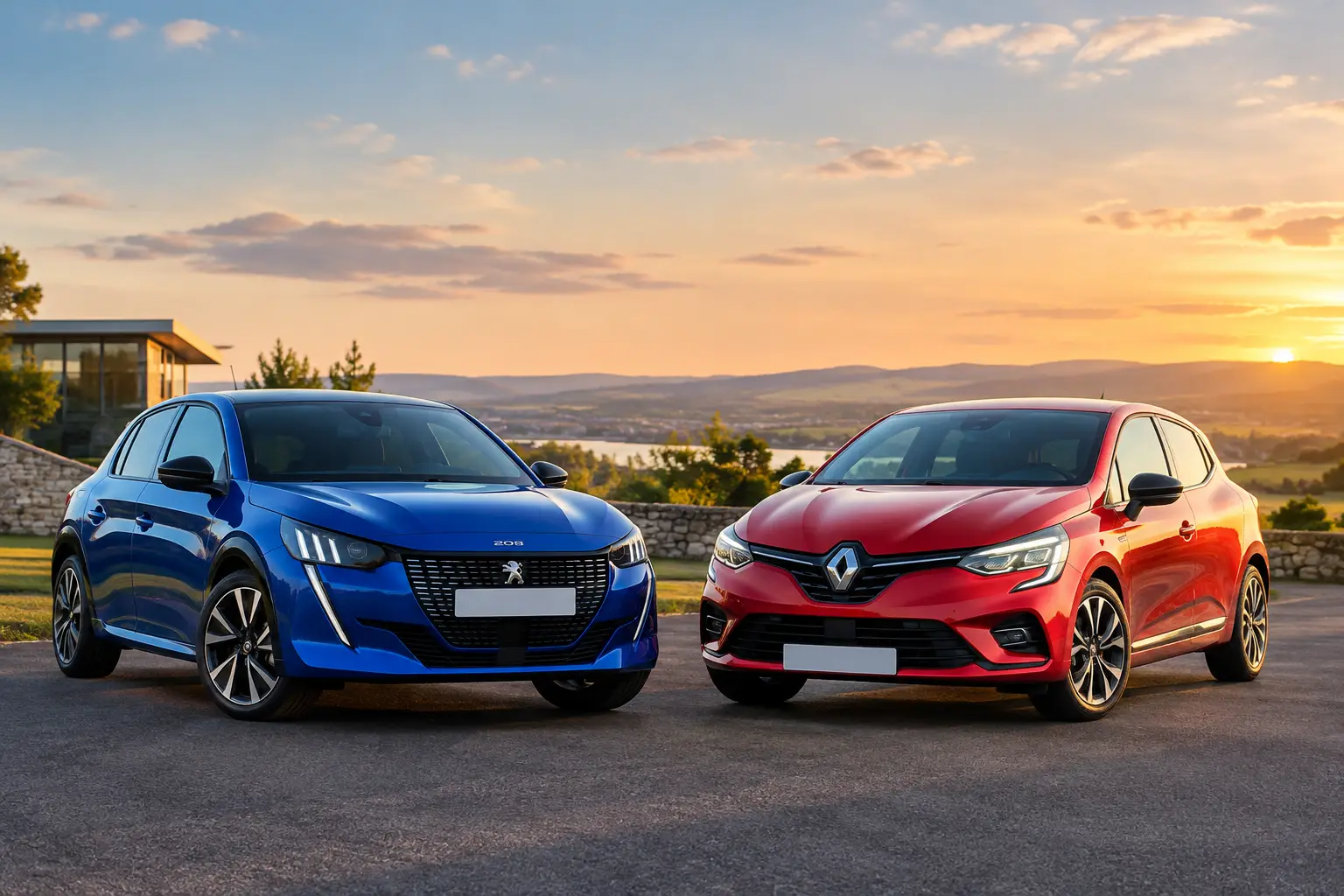
The Peugeot 208 and Renault Clio are two strong contenders for drivers looking for a stylish and economical small car. Both are suitable for everyday commuting and city driving. They also offer modern technology and efficient engine options. However, the differences become clearer when you compare their interiors, fuel economy, boot space and running costs.
The Peugeot 208 vs Renault Clio comparison comes down to what matters most to you. The Peugeot stands out for its distinctive styling and driver-focused cockpit. The Renault is a practical alternative for buyers who value everyday comfort and want the option of a full-hybrid powertrain.
Neither car is the right choice for everyone. Your budget, driving habits and preferred engine will influence which model offers better value.
This comparison examines both cars in detail. It covers their design, interior quality, performance, fuel economy, practicality, reliability and ownership costs to help you make an informed decision.
Peugeot 208 vs Renault Clio: Quick Comparison
| Feature | Peugeot 208 | Renault Clio |
|---|---|---|
| Body style | Five-door hatchback | Five-door hatchback |
| Design | Bold styling and distinctive lighting | Sculpted body and modern styling |
| Interior | Peugeot i-Cockpit layout | More conventional dashboard layout |
| Engine options | Petrol, hybrid and electric versions, depending on model | Petrol and full-hybrid versions, depending on model |
| Boot space | 352 litres for petrol and hybrid versions; 309 litres for the E-208 | Varies by engine and model year |
| Hybrid option | Available in selected versions | E-Tech full hybrid available |
| Best suited to | Drivers who value design and a distinctive cabin | Drivers who prioritise practicality and hybrid efficiency |
Specifications vary by model year and trim. Always check the exact version before buying.
1. Exterior Design: Peugeot 208 vs Renault Clio
Peugeot 208: Bold and Sporty Styling
The Peugeot 208 has a distinctive appearance that helps it stand out in the small-car market. Its sharp body lines and signature three-claw lighting give the front end a sporty character. The sculpted bonnet and modern grille add to its visual appeal.
The overall design feels more expressive than that of a traditional small hatchback. Depending on the trim level, buyers can also find alloy wheels and additional exterior styling features.
The Peugeot 208 is a good choice for drivers who want a compact car with a strong visual identity. Its small dimensions also make it suitable for narrow streets and busy urban parking areas.
Renault Clio: Modern and Refined Styling
The Renault Clio takes a different approach. Its flowing bodywork and carefully shaped front end give it a polished appearance. It looks modern without relying on the same angular styling as the Peugeot.
The Clio’s design also works well for drivers who want a small hatchback that feels suitable for commuting and everyday use.
Which car looks better?
The Peugeot 208 is likely to appeal to buyers who prefer bold styling. The Renault Clio suits those who favour a more understated design. This decision is largely personal, so viewing both cars in person is the best way to decide.
2. Interior Quality and Technology
Peugeot 208 Interior
One of the Peugeot 208’s main selling points is its i-Cockpit interior. The layout combines a compact steering wheel with a raised instrument display and a central touchscreen.
This arrangement gives the cabin a distinctive appearance. It can also make the driving position feel different from that of other small hatchbacks.
However, the steering wheel and instrument display may not suit every driver. Depending on your height and seating position, the steering wheel could obstruct part of the display. Adjust both before deciding whether the layout works for you.
Equipment depends on the model and trim. Available features may include a digital instrument display, smartphone connectivity, climate control and parking assistance.
For more information about Peugeot ownership and maintenance, see our Peugeot 208 problems and common issues guide.
Renault Clio Interior
The Renault Clio uses a more conventional dashboard layout. Its instrument display and infotainment screen are arranged in a familiar way that many drivers will find easy to understand.
The cabin combines practical controls with modern technology. Higher trims may offer additional infotainment features and comfort equipment.
Interior quality and standard equipment vary by version. Buyers should check the exact specification rather than assume every Clio includes the same features.
Interior verdict: The Peugeot 208 offers a more distinctive driving environment. The Renault Clio may be a better fit for drivers who prefer a conventional dashboard. A test drive is important because comfort and visibility depend on personal preference.
3. Boot Space and Practicality
Boot capacity is important when choosing a small hatchback. It affects everyday shopping, luggage and family use.
According to Peugeot UK’s official 208 specifications, petrol and hybrid versions offer 352 litres of boot space. The fully electric E-208 provides 309 litres.
The difference matters if you regularly carry bulky shopping or travel with several bags. Buyers considering the electric version should check whether its available luggage space meets their needs.
The Renault Clio also offers useful luggage capacity. However, the figure depends on the engine and model year. Renault’s published specifications for different Clio versions show that boot capacity can vary significantly between petrol and hybrid models.
Check the manufacturer’s specification for the exact vehicle you intend to buy. Do not assume that every Clio has the same boot capacity.
Rear-seat space also deserves attention. Both cars have five seats, but neither should be treated as a substitute for a larger family car if adults regularly travel in the back.
Which car has the bigger boot?
The Peugeot 208 petrol and hybrid versions offer a clearly stated 352-litre capacity. The electric E-208 has 309 litres. For the Renault Clio, compare the precise powertrain because its luggage capacity varies by version.
4. Engine Options and Performance
Peugeot 208 Engine Options
The Peugeot 208 has been offered with petrol, hybrid and fully electric powertrains, depending on the model year and UK range.
A petrol version can suit drivers who want a familiar engine and straightforward refuelling. A hybrid version may reduce fuel consumption in suitable driving conditions. The E-208 is an alternative for drivers who want fully electric motoring.
Each powertrain has different advantages. Petrol models do not require charging infrastructure. Hybrid models can recover energy during driving. Electric models have no tailpipe emissions and need access to a suitable charging solution.
Before buying, consider your daily mileage and the type of roads you use most often.
Renault Clio Engine Options
The Renault Clio has offered petrol engines and the E-Tech full-hybrid system. The full hybrid combines a petrol engine with electric motors and a battery.
It does not need to be plugged in. The battery is recharged through the system while driving and during deceleration or braking.
This setup can be particularly useful in urban traffic, where frequent slowing and stopping allow the hybrid system to recover energy.
Petrol versions may be more suitable for drivers who prefer a conventional powertrain. The hybrid is worth considering if you want an automatic transmission and spend a lot of time in town.
Performance verdict: Neither model is automatically faster or more enjoyable to drive in every version. Compare engine power, transmission and acceleration figures for equivalent trims. A test drive will reveal more about how each car responds in everyday traffic.
5. Fuel Economy and Running Costs
Fuel economy is a major consideration when comparing the Peugeot 208 and Renault Clio. A car that uses less fuel can reduce your regular expenses, particularly if you commute frequently.
However, official fuel-economy figures are not a guarantee of real-world performance. Traffic, weather, driving style, speed and vehicle load all affect consumption.
When comparing the two models, use official WLTP figures for the exact engine and trim. Avoid comparing the best advertised hybrid figure with an unrelated petrol version.
The Renault Clio E-Tech full hybrid is worth considering for drivers who spend much of their time in urban traffic. Its hybrid system can use electric power during certain driving conditions without requiring an external charge.
The Peugeot 208 hybrid can also help reduce fuel consumption compared with some conventional petrol versions. The result depends on the specific model and how it is driven.
Running costs involve more than fuel. Consider:
- Insurance premiums
- Servicing and maintenance
- Tyres and replacement parts
- Vehicle tax
- Depreciation
- Finance costs
If you are considering an electric E-208, include home charging costs and public charging prices in your calculations.
For a fair comparison, estimate your annual mileage and compare the expected cost of fuel or electricity. Then add insurance and servicing expenses to understand the overall cost of ownership.
6. Ride Comfort and Everyday Driving
The Peugeot 208 is compact and easy to manoeuvre. Its steering and driver-focused cabin give it a distinctive character. This can make it appealing to people who want a small car that feels engaging on urban roads.
Ride comfort depends on the version and wheel size. Larger wheels can affect how the car handles potholes and rough surfaces. Check how the suspension performs on roads you use regularly.
The Renault Clio is designed for everyday driving. It can be a practical choice for commuting and longer journeys. The hybrid version also offers automatic driving convenience.
When testing either car, pay attention to seat comfort, road noise and visibility. Try driving over uneven surfaces and on faster roads. These details can affect your experience more than a specification sheet suggests.
For city driving: Both cars have compact dimensions that help with parking and manoeuvring.
For motorway driving: Compare seat comfort, cabin noise and engine refinement at cruising speed.
The better option depends on your usual routes and personal preferences.
7. Safety and Driver Assistance
Modern versions of the Peugeot 208 and Renault Clio can offer a range of driver-assistance features. Depending on the model and trim, these may include automatic emergency braking, lane assistance, cruise control and parking sensors.
However, not every feature is standard across every version. Check the equipment list for the specific car you are considering.
Safety ratings also need to be interpreted carefully. Testing standards change over time, so ratings from different years may not be directly comparable.
You can check published crash-test information through Euro NCAP. Confirm that the rating applies to the relevant model generation and specification.
During a test drive, check the driver’s visibility and make sure the mirrors and seating position allow you to see clearly. Parking sensors and a reversing camera can also be useful in tight spaces.
8. Peugeot 208 vs Renault Clio Reliability
Reliability depends on the individual vehicle, engine type, maintenance history and previous use. Neither model should be judged on brand reputation alone.
Peugeot 208 Reliability
Some previous-generation Peugeot 208 models with PureTech petrol engines have been associated with timing-belt degradation and oil-consumption concerns. These issues do not affect every vehicle in the same way.
If you are buying a used Peugeot 208, identify the exact engine and check its maintenance requirements. Review the service history and ask whether any relevant repairs or manufacturer support measures apply to the vehicle.
Our Peugeot 208 common problems article explains issues that buyers should investigate before purchasing a used example.
Renault Clio Reliability
The condition of a used Renault Clio also depends on how it has been maintained. Check the service records and inspect the engine, gearbox, suspension and electrical systems.
For a hybrid model, make sure the hybrid system operates correctly. Ask the seller about warranty coverage and arrange a professional inspection if the service history is incomplete.
Which Is More Reliable?
There is no reliable answer for every model year and engine. Compare the precise versions rather than assuming one brand is always more dependable.
Check the vehicle history, MOT records and service documentation. A well-maintained car with a clear history may be a better purchase than a cheaper example with unknown maintenance.
9. Price and Value for Money
The Peugeot 208 price in the UK and the Renault Clio price depend on the model year, trim, engine and dealer offers.
For new cars, compare current manufacturer prices and equipment. A cheaper entry-level version may lack features included in a more expensive trim. Used-car prices also vary with mileage, condition and service history.
Finance offers need careful comparison. Look at the deposit, interest rate, contract length, mileage allowance and total amount payable. A low monthly payment does not always mean a lower overall cost.
Depreciation matters too. Resale value can change according to demand, vehicle condition, mileage and powertrain.
Before choosing either car, request insurance quotes and compare servicing costs. These checks will give you a clearer picture of the total cost of ownership.
For official model details, visit Peugeot UK and Renault UK.
10. Peugeot 208 vs Renault Clio: Which Is Better?
The Peugeot 208 is a strong choice for drivers who want bold styling and a distinctive interior. Its compact dimensions make it suitable for city driving. Buyers can also choose between different powertrains depending on the model year.
The Renault Clio is worth considering if you want a practical hatchback with a conventional cabin layout. Its full-hybrid version can be particularly appealing for drivers who spend a lot of time in urban traffic.
Your final decision should depend on the exact versions you compare.
Choose the Peugeot 208 if you prefer its styling and driving position. Consider the Renault Clio if its comfort, practicality and hybrid option suit your needs better.
Neither model is the automatic winner. Test both cars and compare their specifications, prices and ownership costs before making a decision.
Frequently Asked Questions
Is the Peugeot 208 better than the Renault Clio?
The Peugeot 208 may appeal more to drivers who value distinctive styling and a driver-focused cockpit. The Renault Clio may suit buyers who prioritise everyday practicality and want a full-hybrid option. The better choice depends on the engine, trim and intended use.
Which car has a bigger boot: the Peugeot 208 or Renault Clio?
The Peugeot 208 petrol and hybrid versions offer 352 litres of boot space, while the electric E-208 offers 309 litres. Renault Clio capacity varies by powertrain and model year, so compare the exact specifications before buying.
Which car is cheaper to run?
Running costs depend on fuel economy, insurance, servicing, depreciation and annual mileage. Compare official consumption figures for equivalent versions and obtain insurance quotes before choosing.
Is the Renault Clio E-Tech hybrid self-charging?
Yes. The full-hybrid system recharges its battery while driving and during deceleration or braking. It does not need to be plugged into an external charging point.
Should I buy a used Peugeot 208 or Renault Clio?
Check the service history, mileage, MOT records and mechanical condition of the individual car. Identify the engine and review its maintenance requirements. An independent inspection is useful if you are unsure about the vehicle’s condition.
Is the Peugeot E-208 comparable to the Renault Clio hybrid?
They serve different needs. The E-208 is fully electric and requires access to charging. The Renault Clio full hybrid uses petrol alongside electric assistance and does not need to be plugged in. Compare your driving distances and charging access before deciding.
Final Verdict
The Peugeot 208 vs Renault Clio comparison shows that both cars have clear strengths. The Peugeot offers distinctive styling and a driver-focused cabin. The Renault provides a practical alternative with a full-hybrid option that may suit frequent city driving.
The best choice depends on your priorities. Compare the exact model year and powertrain rather than relying on general claims about either car.
Check current prices and specifications. Test drive both models and review their service requirements before buying. That will help you choose the car that fits your budget and everyday driving needs.
Frequently Asked Questions: Peugeot 208 vs Renault Clio
1. Is the Peugeot 208 better than the Renault Clio?
The Peugeot 208 is a strong choice for drivers who prefer bold styling and a distinctive i-Cockpit interior. The Renault Clio may suit buyers who prioritise everyday practicality and want a full-hybrid option. The better car depends on your budget, driving habits and preferred features.
2. Which car has a bigger boot: Peugeot 208 or Renault Clio?
The Peugeot 208 petrol and hybrid versions offer around 352 litres of boot space. The electric E-208 offers around 309 litres. Renault Clio boot capacity varies by engine and model year. Compare the exact versions before deciding which car offers more luggage space.
3. Which is cheaper to run: the Peugeot 208 or Renault Clio?
Running costs depend on fuel economy, insurance, servicing and depreciation. The Renault Clio E-Tech full hybrid may be economical for frequent city driving. The Peugeot 208 hybrid can also reduce fuel consumption in suitable conditions. Compare official fuel-economy figures and obtain insurance quotes for both cars.
4. Which car is more reliable: Peugeot 208 or Renault Clio?
Reliability depends on the model year, engine and maintenance history. Some older Peugeot 208 PureTech engines have been associated with timing-belt degradation and oil-related concerns. Used Renault Clio models also need careful inspection. Check service records and investigate known issues for the exact engine before buying.
5. Is the Renault Clio hybrid better than the Peugeot 208 hybrid?
Both offer advantages. The Renault Clio E-Tech uses a full-hybrid system that does not require external charging. The Peugeot 208 hybrid also combines petrol power with electric assistance. Compare fuel economy, transmission behaviour, boot space and purchase price to determine which suits your needs.
6. Which car is better for city driving?
Both the Peugeot 208 and Renault Clio are suitable for city driving because of their compact dimensions. The Peugeot offers an agile driving experience, while the Clio full hybrid may appeal to drivers who frequently encounter stop-start traffic. Test both cars to compare visibility, parking ease and low-speed comfort.
7. Which car is more comfortable for motorway driving?
Motorway comfort depends on the engine, trim, wheel size and seating position. The Peugeot 208 offers a driver-focused cabin, while the Renault Clio is designed for everyday use and longer journeys. Test both at higher speeds and compare road noise, seat support and engine refinement.
8. Should I buy a used Peugeot 208 or a used Renault Clio?
Choose based on condition, service history, mileage and the specific engine. Check the MOT history and review any outstanding maintenance requirements. A professional inspection can identify problems that are not obvious during a short test drive. Compare insurance and servicing costs before making your decision.
9. Is the Peugeot E-208 better than the Renault Clio hybrid?
The Peugeot E-208 is fully electric, while the Renault Clio full hybrid uses a petrol engine alongside electric assistance. The E-208 may suit drivers with convenient home or workplace charging. The Clio hybrid can be more practical for buyers who prefer petrol refuelling and do not want to depend on charging facilities.
10. Which car offers better value for money in 2026?
Value for money depends on the purchase price, equipment, fuel economy, insurance and expected depreciation. The Peugeot 208 may appeal to buyers who value its design and cabin layout. The Renault Clio may offer better value for someone who prioritises its hybrid system or practical features. Compare current UK prices and specifications for equivalent versions before choosing.