The Peugeot 2008 vs Renault Captur comparison is worth exploring if you want a stylish, practical and economical small SUV in 2026. Both models offer a raised driving position, modern infotainment systems and efficient engine options. However, they take different approaches to comfort, interior design, boot space and everyday usability.
The Peugeot 2008 stands out with its distinctive exterior styling, driver-focused i-Cockpit and available petrol, hybrid and electric powertrains. Meanwhile, the Renault Captur appeals to buyers who value a flexible rear bench, family-friendly practicality and a choice of petrol and full-hybrid engines.
So, which SUV deserves your money? In this detailed comparison, we look at price, engines, fuel economy, interior quality, boot space, safety and running costs to help you choose the right car for your lifestyle.
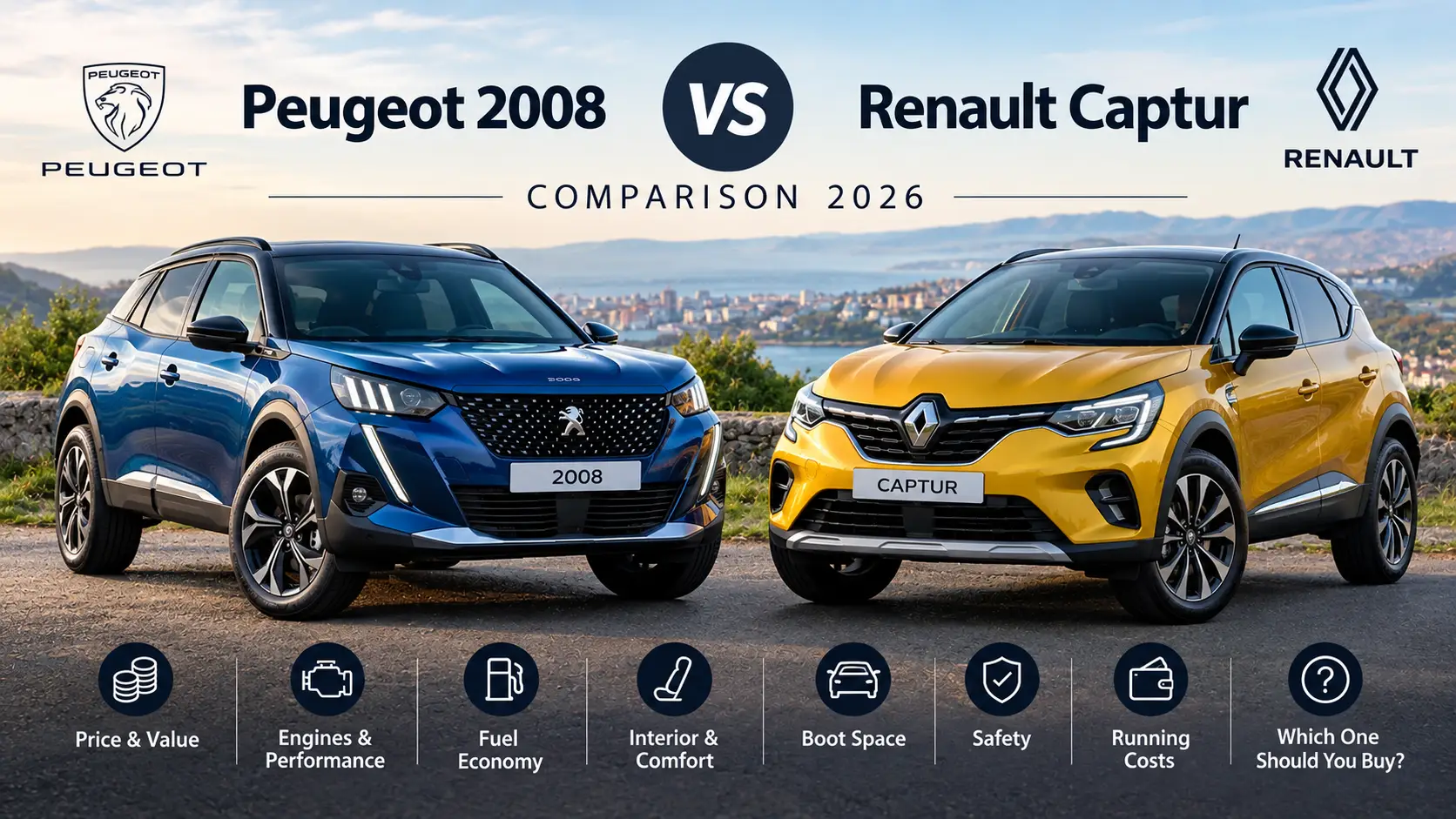
Peugeot 2008 vs Renault Captur: Quick Comparison
Both SUVs compete in the same small-SUV category, making them natural alternatives for drivers who want more ground clearance and practicality than a traditional hatchback.
Nevertheless, their strengths become clearer when you compare the main features side by side.
| Feature | Peugeot 2008 | Renault Captur |
|---|---|---|
| Vehicle type | Compact SUV | Compact SUV |
| Seating capacity | 5 | 5 |
| Petrol options | Available | Available |
| Hybrid options | Self-charging hybrid available | Full hybrid E-Tech available |
| Fully electric version | E-2008 available | No fully electric Captur |
| Interior design | Distinctive Peugeot i-Cockpit | Google-based infotainment on selected trims |
| Standard boot capacity | Approximately 434 litres | Approximately 422 litres in the petrol version with rear bench positioned back |
| Flexible rear seats | Conventional folding rear seats | Sliding rear bench |
| Maximum quoted boot capacity | Up to 1,467 litres with rear seats folded | Up to 1,596 litres with rear seats folded in the applicable petrol configuration |
| Best feature | Styling, cabin design and electric option | Rear-seat flexibility and practical layout |
Boot measurements depend on the model, powertrain, measurement method and rear-seat position. The figures above are indicative UK-market figures, not a claim that every version has the same capacity.
In short, the Peugeot 2008 may appeal more to buyers who prioritise design and cabin technology. By contrast, the Renault Captur offers an interesting alternative for families who regularly need to balance passenger space against luggage capacity.
Peugeot 2008 vs Renault Captur: Price and Value
Purchase price is often one of the first things buyers compare. After all, even a small difference in the monthly payment can affect your overall car-buying budget.
The Renault Captur has a competitive starting price in the UK market. Its official configurator lists petrol and full-hybrid versions, with the final price depending on the engine and trim.
The Peugeot 2008 also offers different petrol and hybrid configurations, as well as the fully electric E-2008. Consequently, the final price depends on whether you choose a conventional engine, a self-charging hybrid or an electric model.
Check the latest prices directly with the manufacturers before making a decision:
Which SUV Offers Better Value?
The Renault Captur could be attractive if you want a lower-cost entry into the small-SUV market. However, the cheapest advertised version is not necessarily the best deal once you compare equipment and finance terms.
On the other hand, the Peugeot 2008 may be worth considering if you prefer its cabin layout, styling or the option of fully electric driving.
Before choosing either vehicle, compare:
- The full on-the-road purchase price.
- Standard equipment and optional extras.
- Deposit and monthly finance payments.
- Interest rates and the total amount payable.
- Insurance premiums.
- Servicing and warranty coverage.
Ultimately, the better-value SUV is the one that provides the features you need without stretching your budget unnecessarily.
Peugeot 2008 vs Renault Captur: Engines and Performance
Engine choice can make a significant difference to your driving experience. Fortunately, both manufacturers offer options for buyers who prefer conventional petrol power or want improved efficiency through electrification.
Peugeot 2008 Engine Options
The UK Peugeot 2008 range includes petrol and hybrid models, with the fully electric E-2008 available separately.
Depending on the current specification, buyers can consider:
- Turbo 100 petrol: A conventional petrol option for drivers who prefer familiar refuelling and a manual gearbox.
- Petrol 130 automatic: An option for buyers who want stronger petrol performance and an automatic transmission.
- Hybrid 145 automatic: A self-charging hybrid that combines petrol power with electric assistance.
- E-2008 electric: A battery-electric SUV for drivers who can charge at home, work or public charging points.
The hybrid system can be especially useful in urban traffic, where electric assistance may reduce petrol consumption under suitable conditions.
If you are considering the electric model, read our Peugeot E-2008 range, price and review guide for more information about charging, range and ownership.
Renault Captur Engine Options
The Renault Captur offers conventional petrol power and a full-hybrid E-Tech option in the current UK range.
The petrol version may suit drivers who want straightforward refuelling and a familiar driving experience. Meanwhile, the full hybrid combines a petrol engine with electric motors and a battery to improve efficiency under suitable conditions.
The hybrid system can operate electrically during some driving situations without requiring the driver to plug the vehicle into a charger.
Which SUV Has Better Performance?
The answer depends on the exact engines you compare. A petrol model and a full hybrid can feel quite different, even when their power figures appear similar.
The Peugeot 2008 Hybrid 145 may suit drivers who want automatic driving with electric assistance. In contrast, the Renault Captur E-Tech full hybrid is worth considering if you want an efficient family SUV with an automatic transmission.
However, headline horsepower is only one part of the story. Acceleration, gearbox response, engine noise and performance when overtaking can all affect how a vehicle feels.
For that reason, test-drive comparable versions of both SUVs before choosing your preferred engine.
Peugeot 2008 vs Renault Captur: Fuel Economy and MPG
Fuel economy is particularly important if you commute every day or regularly cover long distances. Over several years, even a modest difference in petrol consumption can affect your ownership costs.
Peugeot quotes combined fuel consumption of approximately 45.2–54.5 mpg for selected Turbo 100 configurations and 51.3–62.4 mpg for the Hybrid 145, depending on specification.
The Renault Captur also offers different efficiency figures according to the engine. Its full-hybrid E-Tech version can achieve higher official MPG figures than the conventional petrol model under the relevant test conditions.
Nevertheless, official WLTP figures are designed to help buyers compare vehicles. They do not guarantee the fuel economy you will achieve on the road.
Which Is More Economical to Drive?
The Renault Captur E-Tech could be a strong choice for drivers who want a full hybrid with potentially high official fuel economy. Likewise, the Peugeot 2008 Hybrid deserves consideration if you prefer Peugeot’s design and driving environment.
Your actual results will depend on several factors:
- The engine and trim you select.
- How much time you spend in urban traffic.
- Your average motorway speed.
- Weather and outside temperature.
- Vehicle load and tyre pressure.
- Your driving style.
For example, frequent stop-start driving may allow a hybrid system to recover more energy and use electric assistance. However, long motorway journeys can produce different results.
Therefore, compare official figures for the exact vehicles and check independent real-world tests before deciding which model is likely to cost less to fuel.
Peugeot 2008 vs Renault Captur: Interior and Comfort
Interior design is one of the clearest differences between these two small SUVs.
The Peugeot 2008 features the brand’s distinctive i-Cockpit, which combines a compact steering wheel with digital instrumentation and a central touchscreen. This arrangement gives the cabin a modern, driver-focused appearance.
By comparison, the Renault Captur takes a more conventional approach to the driving position while offering a portrait-style touchscreen and Google-based infotainment on selected versions.
Peugeot 2008 Interior
The Peugeot 2008 has a contemporary dashboard design, with technology and styling playing a central role.
Depending on the trim, available equipment can include:
- Digital instrument displays.
- A central touchscreen.
- Smartphone connectivity.
- Navigation and connected services.
- Automatic climate control.
- Parking sensors and a reversing camera.
- Driver-assistance systems.
One important consideration is the i-Cockpit driving position. Some drivers appreciate the compact steering wheel and elevated instrument display, while others may find it takes time to adjust.
Consequently, check that you can see the instruments comfortably before committing to a purchase.
Renault Captur Interior
The Renault Captur focuses on everyday usability, with a straightforward control layout and useful cabin storage.
Selected versions offer Google-based infotainment features, including connected navigation and voice-assistant functionality. However, the precise equipment depends on the trim and model year.
The Captur’s sliding rear bench is another practical advantage. It allows you to prioritise passenger legroom or luggage capacity depending on your needs.
Which Interior Is Better?
The Peugeot 2008 may appeal more if you enjoy distinctive styling and a technology-focused dashboard. Meanwhile, the Renault Captur could be a better match if you value a familiar layout and flexibility for passengers.
Neither cabin is automatically better for every driver. Sit in both vehicles, adjust the seats and steering wheel, and try the infotainment systems before making your choice.
Peugeot 2008 vs Renault Captur: Boot Space and Practicality
Boot space can be a deciding factor when choosing a family SUV. Shopping, pushchairs, suitcases and sports equipment all require room, particularly when you travel with passengers.
The Peugeot 2008 provides approximately 434 litres of boot capacity in the standard configuration, with up to 1,467 litres quoted when the rear seats are folded.
The Renault Captur’s petrol version offers approximately 422 litres with the rear bench positioned back. However, moving the bench forward can increase the quoted capacity to as much as 616 litres. With the rear seats folded, the applicable petrol configuration can provide up to 1,596 litres.
These maximum figures need context. Moving the Captur’s rear bench forward reduces the space available to rear passengers, while its full-hybrid version has a smaller boot because of its different powertrain packaging.
Which SUV Has the Bigger Boot?
The answer depends on the exact configuration and how you measure practicality.
The Peugeot 2008 offers a competitive standard luggage area and useful space when the rear seats are folded. Meanwhile, the Renault Captur’s sliding bench gives it additional flexibility when you need to carry more luggage.
For families, the Captur’s ability to change the balance between rear-seat space and boot capacity is particularly useful. However, the Peugeot may still meet your needs if its standard boot layout suits your usual shopping and travel requirements.
If possible, take your own luggage or pushchair to a dealership. That practical test can be more valuable than comparing maximum capacity figures alone.
Peugeot 2008 vs Renault Captur: Dimensions and City Driving
Both vehicles are designed for drivers who want an SUV-style driving position without moving into a much larger family vehicle.
The Peugeot 2008 is approximately 4,304 mm long, while the Renault Captur measures around 4,239 mm. Exact dimensions can vary slightly according to specification.
Their compact footprints make both vehicles suitable for many urban environments. Nevertheless, visibility, steering response and parking assistance can influence which one feels easier to manage.
Peugeot 2008 in the City
The Peugeot offers a raised driving position, a modern cockpit and available parking assistance. Its exterior styling gives it a more substantial appearance than a conventional hatchback, although the size remains manageable for everyday use.
Renault Captur in the City
The Renault Captur combines compact SUV dimensions with a practical cabin. Its available parking sensors and reversing camera can make low-speed manoeuvres easier, depending on the trim.
The best option depends on your surroundings and driving habits. If you regularly park in narrow streets or crowded car parks, try both vehicles in a similar environment before choosing.
Peugeot 2008 vs Renault Captur: Technology and Safety
Modern small SUVs offer more than basic transport. Both models can provide infotainment, smartphone connectivity and driver-assistance features designed to make everyday driving more convenient.
Peugeot 2008 Technology
Depending on specification, the Peugeot 2008 can include:
- A digital instrument display.
- A central infotainment touchscreen.
- Smartphone integration.
- Navigation and connected services.
- Parking sensors and camera assistance.
- Automatic emergency braking.
- Lane-related driver assistance.
- Traffic-sign recognition.
Renault Captur Technology
Selected Renault Captur versions offer:
- A central touchscreen.
- Google-based infotainment.
- Connected navigation.
- Smartphone connectivity.
- Automatic climate control.
- Parking assistance.
- Driver-assistance features.
However, not every feature is standard on every version. Always check the equipment list for the exact model year and trim you intend to buy.
Which SUV Is Safer?
Safety should not be judged solely by the number of driver-assistance features advertised.
Independent crash-test ratings depend on the vehicle generation, test date and specification. Therefore, consult Euro NCAP and verify that the results you review apply to the exact generation you are considering.
In addition, check which safety systems are included as standard rather than available only as optional extras or on higher trims.
Peugeot 2008 vs Renault Captur: Running Costs
The purchase price is only one part of owning an SUV. Fuel, insurance, servicing, tyres, finance and depreciation all affect how much you spend over time.
The Renault Captur may appeal to buyers looking for a competitively priced small SUV with a full-hybrid option. Meanwhile, the Peugeot 2008 offers petrol and hybrid versions, as well as the fully electric E-2008 for buyers who want to avoid petrol consumption.
However, the cheapest car to buy is not always the cheapest to own.
Before making a decision, compare:
- Annual fuel or electricity costs.
- Insurance quotations for the exact trim.
- Scheduled servicing expenses.
- Tyre replacement costs.
- Warranty coverage.
- Finance interest and total payments.
- Expected depreciation.
- Charging costs if you choose an electric vehicle.
For example, a hybrid could cost more upfront but potentially save fuel in certain driving conditions. Similarly, an electric vehicle may reduce energy costs for someone who charges at home, although the overall saving depends on electricity prices and purchase cost.
Calculate your expected expenses over three to five years rather than relying on the monthly payment alone.
Peugeot 2008 vs Renault Captur: Pros and Cons
Each SUV has strengths and compromises. Reviewing them together can help you identify which vehicle is better suited to your priorities.
Peugeot 2008 Pros
- Distinctive exterior styling.
- Modern, technology-focused i-Cockpit.
- Competitive standard boot capacity.
- Petrol and self-charging hybrid options.
- Fully electric E-2008 available.
- A range of comfort and driver-assistance features.
Peugeot 2008 Cons
- The driving position may not suit every driver.
- Rear-seat accommodation can feel restrictive for some adults.
- Higher trims can increase the purchase price.
- Automatic and hybrid versions may cost more than entry-level petrol models.
Renault Captur Pros
- Practical interior layout.
- Sliding rear bench for added flexibility.
- Useful luggage capacity in the petrol version.
- Full-hybrid E-Tech option.
- Google-based infotainment on selected trims.
- A competitive entry point into the small-SUV market.
Renault Captur Cons
- Hybrid versions have less boot capacity than the petrol version.
- Moving the rear bench forward reduces passenger legroom.
- Equipment varies between trim levels.
- Ride comfort and powertrain response should be assessed on a test drive.
Overall, the Peugeot is appealing for buyers who prioritise styling and cabin technology. In contrast, the Renault offers a strong practical argument for families who regularly need to adjust the space available for passengers and luggage.
Peugeot 2008 vs Renault Captur: Which Should You Buy in 2026?
The right choice depends on how you drive, what you carry and which features matter most.
Choose the Peugeot 2008 If:
- You prefer its distinctive exterior styling.
- You like the Peugeot i-Cockpit layout.
- You want to compare petrol and self-charging hybrid versions.
- You are interested in a fully electric SUV.
- Its cabin and driving position suit you better.
Choose the Renault Captur If:
- You value flexible rear-seat space.
- You frequently balance passenger comfort with luggage capacity.
- You want to consider a full-hybrid powertrain.
- You prefer its infotainment layout.
- Its purchase price and equipment offer better value for your budget.
Before deciding, compare equivalent powertrains and trim levels. Then test-drive both vehicles on the roads you normally use.
You can also explore our Peugeot 2008 problems and reliability guide if you are considering a used model. For a wider view of the manufacturer’s electric range, see our Peugeot electric cars guide.
Final Verdict: Peugeot 2008 or Renault Captur?
The Peugeot 2008 and Renault Captur are both worth considering if you want a modern small SUV in 2026. However, their different strengths mean the better choice depends on your everyday requirements.
The Peugeot 2008 stands out with its distinctive design, technology-focused cabin and choice of petrol, hybrid and fully electric powertrains. It is a strong candidate for drivers who appreciate the Peugeot driving environment and want the flexibility to compare several types of powertrain.
The Renault Captur, meanwhile, makes a convincing case through its sliding rear bench, family-friendly practicality and full-hybrid option. That flexible seating arrangement is particularly useful when your luggage requirements change from one journey to another.
Our recommendation: Choose the Peugeot 2008 if styling, cabin design and the electric option matter most. Consider the Renault Captur if flexible rear-seat space and its full-hybrid system better match your needs.
Finally, compare the exact prices, equipment, insurance quotations and running costs. A proper test drive of both vehicles will help you make a decision based on comfort and practicality rather than specifications alone.
Frequently Asked Questions
1. Is the Peugeot 2008 better than the Renault Captur?
The Peugeot 2008 may suit buyers who prefer distinctive styling, the i-Cockpit interior and a fully electric option. However, the Renault Captur can be more attractive to families who value a sliding rear bench and flexible luggage space. The best choice depends on your budget and priorities.
2. Which is cheaper, the Peugeot 2008 or Renault Captur?
The Renault Captur has a competitive starting price in the UK market. However, the final cost depends on the engine, trim, equipment and current offers. Compare the latest manufacturer prices for equivalent versions before buying.
3. Which SUV has better fuel economy?
Both offer efficient powertrain options. The Peugeot 2008 Hybrid and Renault Captur E-Tech full hybrid can deliver strong official fuel economy figures, depending on specification. Compare the exact WLTP figures and independent real-world results before deciding.
4. Which has more boot space, the Peugeot 2008 or Renault Captur?
The Peugeot 2008 offers approximately 434 litres in its standard configuration. The Renault Captur petrol version offers approximately 422 litres with the rear bench positioned back, increasing to as much as 616 litres when the bench is moved forward. However, this reduces rear passenger space, and the hybrid version has a smaller boot.
5. Is the Renault Captur available as a hybrid?
Yes. The UK Renault Captur range includes the full-hybrid E-Tech option, depending on current availability. It combines petrol power with electric assistance and does not require external charging.
6. Is the Peugeot 2008 available as an electric car?
Yes. The Peugeot E-2008 is the fully electric version of the compact SUV. It is worth considering if you have convenient charging access and want to drive without using petrol. Check the latest official range and charging specifications before buying.
7. Which SUV is better for families?
Both can suit small families. The Peugeot 2008 offers a practical boot and modern cabin, while the Renault Captur’s sliding rear bench allows you to adjust the balance between passenger legroom and luggage capacity. Try both vehicles with your family before deciding.
8. Which car is more comfortable for long journeys?
Comfort depends on the seats, suspension, engine and road conditions. Both SUVs can be suitable for longer journeys, but ride quality and engine noise may differ. Test-drive each model on faster roads as well as around town.
9. Is the Peugeot 2008 more expensive to maintain?
Maintenance costs depend on the engine, age, service schedule, parts and labour rates. Neither vehicle is guaranteed to be cheaper to maintain in every situation. Compare service plans, warranty coverage, insurance and repair estimates before making a decision.
10. Should I buy the Peugeot 2008 or Renault Captur in 2026?
Choose the Peugeot 2008 if its styling, i-Cockpit and electric option appeal to you. The Renault Captur may be a better fit if you value rear-seat flexibility and want to consider its full-hybrid powertrain. Compare equivalent trims and take both cars for a test drive before purchasing.
Prices, equipment and specifications can change. This comparison focuses on UK-market models. Always confirm current details with the manufacturers before placing an order.