Peugeot 3008 MPG & Fuel Economy 2026: Complete Guide
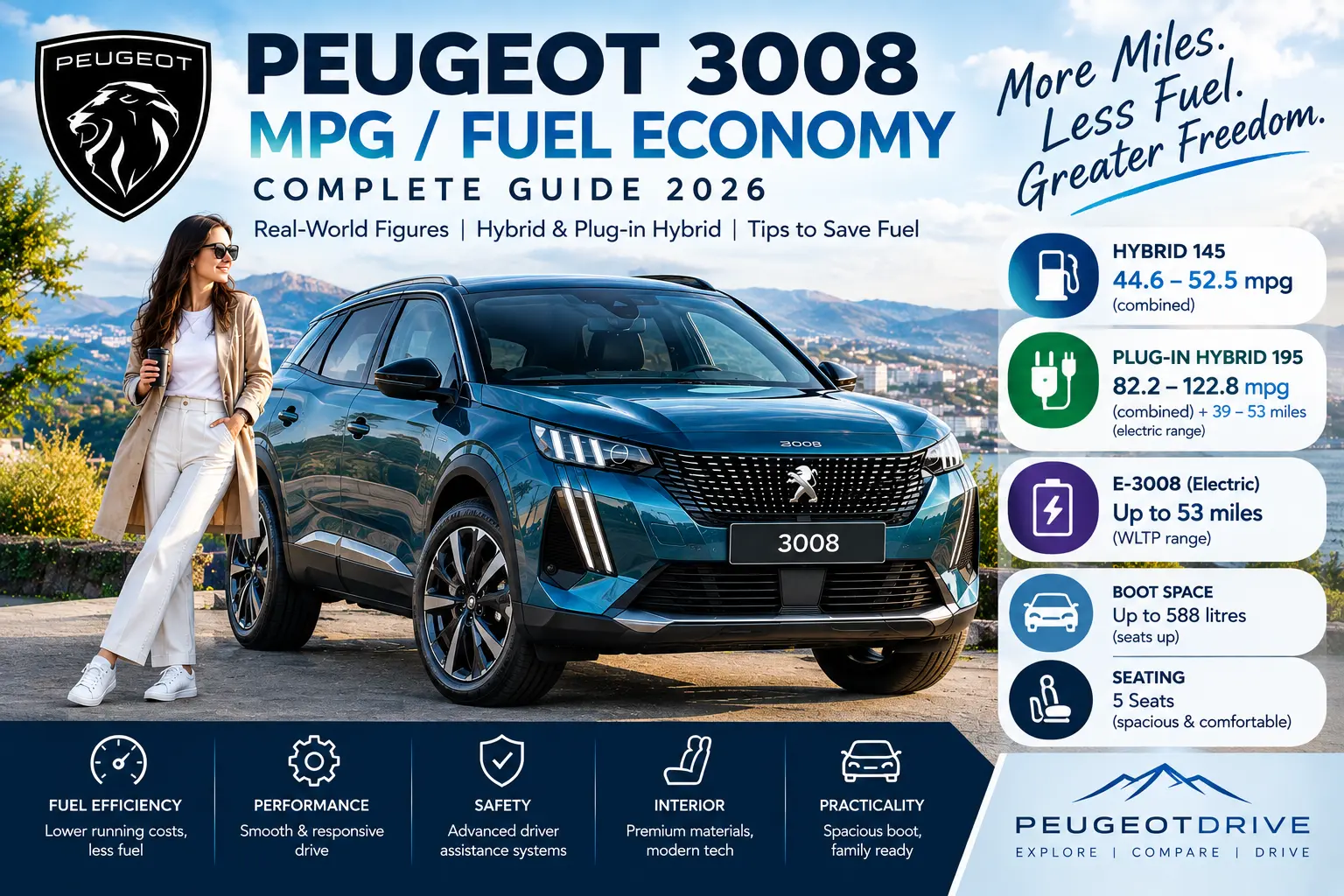
The Peugeot 3008 MPG figure is an important consideration for anyone looking at this stylish family SUV. Fuel economy affects your weekly fuel bill, long-distance running costs and the overall affordability of owning a vehicle.
The current Peugeot 3008 range gives buyers several powertrain choices, including a self-charging Hybrid 145, a Plug-in Hybrid 195, and fully electric E-3008 versions. Consequently, buyers have more ways to balance performance, practicality and running costs than before.
According to current Peugeot UK figures, the 3008 Hybrid has an official combined fuel economy range of approximately 44.6–52.5 mpg, depending on specification. The Plug-in Hybrid has an official combined figure of approximately 82.2–122.8 mpg, while its electric-only WLTP range is around 39–53 miles depending on version.
However, these figures need some explanation.
Official WLTP figures are designed to provide a standardised comparison between vehicles. They do not guarantee the MPG that every driver will achieve on every journey. Weather, speed, traffic, driving style, vehicle load, tyres and accessories can all affect real-world fuel consumption.
Therefore, this guide explains Peugeot 3008 MPG, fuel economy, hybrid efficiency, plug-in hybrid consumption, real-world driving and practical ways to reduce fuel costs.
Peugeot 3008 MPG at a Glance
Here is a simple overview of the current UK powertrain options.
| Peugeot 3008 Version | Power | Transmission | Official Economy |
|---|---|---|---|
| Hybrid 145 | 145 hp | 6-speed automatic | 44.6–52.5 mpg |
| Plug-in Hybrid 195 | 195 hp | 7-speed automatic | 82.2–122.8 mpg |
| E-3008 | Electric | Automatic | Measured by electricity consumption, not MPG |
The standard Hybrid 145 is particularly interesting because it does not require external charging. Its battery is recharged automatically through energy recovery while driving.
The Plug-in Hybrid, on the other hand, can be charged externally and offers considerably more electric driving capability.
For buyers who want to eliminate petrol consumption altogether, the E-3008 provides a fully electric alternative.
What Is a Good MPG for the Peugeot 3008?
For a relatively large family SUV, an official combined figure reaching 52.5 mpg is respectable.
The 3008 is larger and heavier than a small hatchback such as the Peugeot 208. Therefore, it naturally requires more energy to move.
The Hybrid 145 is designed to reduce fuel consumption by using electric assistance when conditions allow. Peugeot states that the system can reduce fuel consumption by up to 16% compared with the equivalent petrol engine and by up to 29% in town under suitable conditions.
However, the highest published MPG should not be treated as a guaranteed result.
A driver who spends most of the week in city traffic may experience a different consumption pattern from someone who spends most of the time on motorways.
As a result, your driving environment is just as important as the engine specification.
Peugeot 3008 Hybrid MPG
The standard Peugeot 3008 Hybrid 145 is currently one of the most important versions in the range.
It combines a petrol engine with an electric motor and uses a six-speed e-DSC6 automatic transmission.
Peugeot currently quotes official combined fuel consumption of approximately 44.6–52.5 mpg, depending on specification.
This makes the Hybrid 145 an interesting middle ground.
You get some of the efficiency advantages of electrification without having to establish a regular charging routine.
Does the Peugeot 3008 Hybrid Need Charging?
No.
This is one of its biggest advantages.
The Hybrid 145 is a self-charging hybrid. The vehicle can recover energy during deceleration and braking, which helps recharge the hybrid battery.
The system then uses the stored energy to provide electric assistance when appropriate.
Consequently, you can use the car much like a conventional petrol SUV.
You refuel at a petrol station, while the vehicle automatically manages the hybrid system in the background.
This can be especially convenient for drivers who:
- Do not have a home charger
- Regularly travel long distances
- Drive in mixed conditions
- Want automatic transmission
- Want some electrification without charging
Peugeot 3008 Hybrid MPG in City Driving
City driving is where hybrid technology can become particularly useful.
Urban journeys usually involve frequent:
- Stops
- Starts
- Braking
- Acceleration
- Low-speed driving
- Traffic queues
These conditions give the hybrid system opportunities to recover energy and use electric assistance.
Peugeot states that the 3008 Hybrid can spend more than 50% of driving time in electric mode in town, under suitable conditions.
This does not mean that more than half of your total mileage will necessarily be electric.
Instead, it refers to driving time in particular urban conditions.
Therefore, a commuter who spends a significant amount of time in town may see more benefit from the hybrid system than someone who spends nearly every journey travelling at motorway speeds.
Peugeot 3008 MPG on Motorways
Motorway driving changes the equation.
At higher speeds, aerodynamic resistance increases significantly. The petrol engine also has to work more consistently to maintain speed.
As a result, the fuel-saving advantage of the hybrid system can become less noticeable compared with slower urban driving.
That does not mean the 3008 Hybrid is unsuitable for motorways.
It remains a practical long-distance SUV because the petrol engine provides flexibility without requiring charging stops.
However, drivers should not expect the highest advertised MPG figure during sustained high-speed motorway journeys.
How to Improve Motorway MPG
You can improve fuel economy by:
- Maintaining a steady speed
- Avoiding unnecessary acceleration
- Using cruise control where appropriate
- Checking tyre pressures
- Removing unnecessary luggage
- Avoiding unnecessary roof accessories
- Anticipating traffic
- Allowing adequate following distance
Smooth driving generally uses less fuel than repeated hard acceleration followed by heavy braking.
Peugeot 3008 Plug-in Hybrid MPG
The Peugeot 3008 Plug-in Hybrid 195 works differently from the standard Hybrid 145.
Because it has a larger battery, it can travel considerably further using electric power when sufficiently charged.
Peugeot currently quotes an official combined fuel economy figure of approximately 82.2–122.8 mpg, depending on specification, together with an electric-only WLTP range of approximately 39–53 miles.
However, plug-in hybrid MPG figures require careful interpretation.
The official combined figure assumes a mixture of electric and petrol driving under the WLTP test procedure.
If you regularly charge the vehicle and use its electric range for your daily journeys, petrol consumption can potentially be very low.
On the other hand, if you rarely charge the battery, the real-world benefit can be significantly smaller.
Why Plug-in Hybrid MPG Can Be Misleading
A plug-in hybrid can produce an impressive official MPG number because the test combines electric driving with petrol use.
For example, imagine that your daily commute is comfortably within the car’s electric range and you recharge every night.
You could complete much of your everyday driving without using the petrol engine.
However, consider another driver who rarely charges the vehicle.
That driver may rely much more heavily on the petrol engine, particularly on longer journeys.
Therefore, the published PHEV MPG figure should not be interpreted in exactly the same way as the MPG figure for a conventional petrol or self-charging hybrid.
For plug-in hybrids, charging behaviour is a major part of fuel economy.
Peugeot 3008 Hybrid vs Plug-in Hybrid MPG
Which one is more economical?
The answer depends on how you use the vehicle.
| Feature | Hybrid 145 | Plug-in Hybrid 195 |
|---|---|---|
| External charging | No | Yes |
| Electric driving | Short assistance | Much longer electric range |
| Official MPG | 44.6–52.5 mpg | 82.2–122.8 mpg |
| Electric range | Limited hybrid assistance | Up to around 53 miles WLTP |
| Best for | Mixed driving | Regular charging + shorter daily trips |
| Long journeys | Very convenient | Petrol backup available |
| Charging routine | Not required | Important for maximum efficiency |
Choose the Hybrid 145 if:
- You cannot charge at home
- You regularly make unpredictable journeys
- You want simple petrol refuelling
- You mix urban and motorway driving
- You do not want to plan charging
Choose the Plug-in Hybrid if:
- You can charge at home or work
- Your daily mileage is relatively short
- You want more electric driving
- You can charge frequently
- You want petrol flexibility for long trips
Neither option is automatically better.
The best choice depends on your lifestyle.
Peugeot 3008 Real-World MPG
Official MPG figures are useful, but many buyers really want to know:
“How much fuel will my Peugeot 3008 actually use?”
There is no universal answer.
Real-world MPG can vary considerably between drivers.
For example, two people could drive identical 3008 Hybrid models but achieve different results because one drives mostly through urban traffic while the other drives long motorway journeys.
Important factors include:
Driving Style
Aggressive acceleration uses more energy.
A smooth driver who anticipates traffic can often achieve better fuel economy.
Average Speed
Higher speeds generally increase fuel consumption.
This is particularly noticeable on motorways.
Traffic
Stop-start traffic can increase petrol consumption, although the hybrid system can recover energy during deceleration.
Weather
Cold temperatures, strong winds, rain and other conditions can affect efficiency.
Vehicle Load
Carrying several passengers and heavy luggage increases the amount of energy required to move the vehicle.
Tyre Pressure
Incorrect tyre pressures can increase rolling resistance.
Air Conditioning and Heating
Heating and cooling systems require energy and can affect consumption.
Peugeot specifically warns that real-world fuel consumption can vary according to weather, accessories, driving style and vehicle load.
Therefore, official MPG should be treated as a comparison figure rather than a promise.
Peugeot 3008 MPG: What Happens in Winter?
Cold weather can affect fuel economy.
During winter, the engine may take longer to reach its ideal operating temperature. In addition, drivers may use heating, heated seats, lights and demisting systems more frequently.
For hybrid vehicles, battery performance can also be affected by temperature.
Consequently, it is normal for your MPG to vary throughout the year.
Instead of judging the vehicle from one tank of fuel, monitor your average consumption over several months.
This gives you a much more realistic picture.
How to Improve Peugeot 3008 Fuel Economy
If you already own a Peugeot 3008, there are several practical ways to reduce fuel consumption.
1. Drive Smoothly
Avoid rapid acceleration whenever it is unnecessary.
Progressive acceleration is generally more efficient.
2. Anticipate Traffic
Look ahead and anticipate junctions, traffic lights and slower vehicles.
This allows you to reduce speed gradually instead of accelerating and braking repeatedly.
3. Maintain Correct Tyre Pressure
Check your tyres regularly and use Peugeot’s recommended pressures.
Properly inflated tyres can help reduce rolling resistance.
4. Remove Unnecessary Weight
Do not carry heavy objects in the boot unless you need them.
Likewise, remove unused roof equipment because it can increase aerodynamic drag.
5. Reduce Excessive Speed
High-speed driving can significantly increase energy consumption.
A steady, sensible speed can improve motorway efficiency.
6. Use the Hybrid System Properly
With the standard hybrid, smooth driving and anticipation can give the energy recovery system more opportunities to operate.
7. Keep the Vehicle Maintained
Regular servicing, correct tyre condition and proper maintenance can help the vehicle operate efficiently.
8. Plan Your Journeys
Combining several short trips into one journey can sometimes reduce unnecessary fuel use.
Peugeot 3008 MPG and Running Costs
Fuel economy is important, but it is only one part of the total ownership cost.
When calculating the real cost of owning a 3008, consider:
- Petrol
- Electricity for plug-in charging
- Insurance
- Servicing
- Tyres
- Repairs
- Finance
- Depreciation
- Parking
- Applicable taxes and registration costs
For example, a higher trim may provide desirable equipment but cost more to purchase.
Similarly, larger wheels can affect tyre replacement costs and may influence efficiency.
Therefore, do not choose a car based solely on the highest MPG number.
Instead, calculate the expected total cost over the period you intend to own the vehicle.
Peugeot 3008 MPG vs Peugeot 2008 MPG
If fuel economy is your biggest priority, you may also be considering the smaller Peugeot 2008.
The 2008 is lighter and smaller than the 3008, so it can offer better official fuel economy in comparable hybrid configurations.
For example, Peugeot currently quotes up to 62.4 mpg for the 2008 Hybrid 145, while the 3008 Hybrid 145 reaches up to 52.5 mpg.
However, the 3008 provides additional size, interior space and family-SUV practicality.
Therefore, you should decide whether the additional space is worth the potential fuel-consumption difference.
For a broader model comparison, you can also read our guide to the best Peugeot SUVs in 2026.
Peugeot 3008 MPG vs Nissan Qashqai
The Peugeot 3008 also competes directly with vehicles such as the Nissan Qashqai.
Both are designed as family SUVs, but their powertrains and efficiency figures vary between versions.
If fuel economy is a deciding factor, compare like-for-like versions rather than comparing the best MPG figure from one model against a different powertrain from another.
Our Peugeot 3008 vs Nissan Qashqai comparison provides a broader look at fuel economy, practicality, technology and value.
Peugeot 3008 Hybrid vs E-3008
The fully electric E-3008 is a completely different proposition.
Instead of measuring fuel economy in MPG, electric vehicles are assessed using electricity consumption and range.
The E-3008 can be particularly attractive if you have reliable access to home or workplace charging.
Choose the Hybrid 3008 if:
- You want petrol flexibility
- You do not have reliable charging
- You regularly travel long distances
- You want a simple refuelling routine
- You want hybrid assistance without plugging in
Choose the E-3008 if:
- You can charge at home
- Most journeys are predictable
- You want fully electric driving
- You want to eliminate petrol use
- You are comfortable planning longer trips around charging
If you are considering the electric version, our Peugeot E-3008 range, price and features guide provides a more detailed look at its batteries, range and charging.
Is the Peugeot 3008 Fuel Efficient for a Family SUV?
Yes, particularly when you choose the hybrid powertrain and your driving pattern suits it.
The 3008 is a larger SUV, so buyers should not expect the same MPG as a small hatchback.
Nevertheless, the Hybrid 145 provides a useful combination of petrol flexibility and electric assistance.
For urban and mixed driving, it can be an efficient alternative to a conventional petrol SUV.
The Plug-in Hybrid can potentially deliver much lower petrol use if it is charged regularly and most daily journeys fit within its electric range.
However, if you never charge a PHEV, you may not receive the full benefit of the technology.
Peugeot 3008 MPG: Pros and Cons
Pros
- Strong official MPG for a family SUV
- Hybrid 145 does not require external charging
- Useful electric assistance in urban driving
- Plug-in Hybrid offers much more electric driving capability
- Petrol engine provides long-distance flexibility
- Automatic transmissions
- Practical five-seat SUV layout
- Multiple powertrain choices
Cons
- Real-world MPG can be lower than WLTP figures
- Motorway driving can reduce hybrid efficiency
- Plug-in hybrid economy depends heavily on regular charging
- Larger SUVs generally use more fuel than smaller cars
- Higher trims and larger wheels can increase ownership costs
- PHEV MPG figures can be misunderstood if charging habits are ignored
How Much Can the Peugeot 3008 Save on Fuel?
The answer depends on your mileage and driving pattern.
Suppose you drive mainly in town.
A hybrid can potentially reduce fuel consumption because the electric motor can assist more frequently.
Now consider a driver who travels almost exclusively on motorways.
The hybrid system may still provide benefits, but the difference could be less dramatic.
For a plug-in hybrid driver who charges every night, the savings can be greater because many daily journeys can be completed partly or entirely using electric power.
Therefore, the best way to estimate your potential savings is to calculate:
Annual mileage ÷ real-world MPG × current fuel price
For a PHEV, also include your electricity cost.
This gives you a much more realistic ownership estimate than simply comparing brochure MPG figures.
Peugeot 3008 MPG: Buyer Tips
Before buying a Peugeot 3008, ask yourself:
How many miles do I drive each year?
Higher annual mileage makes fuel efficiency more important.
How much of my driving is urban?
More urban driving may make the standard hybrid particularly attractive.
Can I charge at home?
If yes, compare the PHEV and E-3008 more carefully.
Do I regularly drive long distances?
If yes, petrol flexibility may be valuable.
Do I need the space of a 3008?
If not, a smaller Peugeot could potentially offer better economy.
Have I compared total ownership costs?
Include insurance, servicing, fuel, electricity, tyres and depreciation.
Have I taken a test drive?
A test drive can help you understand how the hybrid system feels in real traffic.
Final Verdict: Is the Peugeot 3008 Economical?
The Peugeot 3008 can be an economical family SUV, particularly when you choose the powertrain that matches your driving habits.
The standard Hybrid 145 currently offers official combined fuel economy of approximately 44.6–52.5 mpg. It is particularly appealing because it provides hybrid assistance without requiring external charging.
The Plug-in Hybrid 195 has a much higher official combined MPG figure of approximately 82.2–122.8 mpg, but this figure depends heavily on regular charging and the proportion of electric driving.
For buyers who can charge at home, the E-3008 provides another route to reducing petrol use completely.
Ultimately, however, the most economical 3008 is not necessarily the one with the highest brochure MPG.
The right choice depends on how you actually drive.
If you mostly drive around town and want simple ownership, the Hybrid 145 is a strong option.
If you have home charging and short daily journeys, the Plug-in Hybrid could offer greater fuel savings.
If you want to stop using petrol altogether and have convenient charging access, the E-3008 deserves serious consideration.
Most importantly, remember that WLTP figures are comparison figures. Your real-world MPG will depend on speed, traffic, weather, load, tyres, driving style and, for a plug-in hybrid, how regularly you charge.
10 FAQs About Peugeot 3008 MPG and Fuel Economy
1. What MPG does the Peugeot 3008 get?
The current Peugeot 3008 Hybrid 145 has an official combined fuel economy range of approximately 44.6–52.5 mpg, depending on specification.
2. Which Peugeot 3008 has the best MPG?
The Plug-in Hybrid has the highest official combined MPG figure, at approximately 82.2–122.8 mpg, but this figure assumes a combination of electric and petrol driving.
3. Is the Peugeot 3008 Hybrid fuel efficient?
Yes. The Hybrid 145 combines a petrol engine with electric assistance and can achieve up to around 52.5 mpg under the official WLTP test procedure.
4. Does the Peugeot 3008 Hybrid need charging?
No. The standard Hybrid 145 is self-charging and recovers energy during deceleration and braking.
5. How economical is the Peugeot 3008 Plug-in Hybrid?
The current Plug-in Hybrid 195 is officially rated at approximately 82.2–122.8 mpg combined, with an electric-only WLTP range of around 39–53 miles depending on version.
6. Is Peugeot 3008 MPG better in the city?
The hybrid system can be particularly useful in urban driving because it can use electric assistance and recover energy during frequent slowing and braking.
7. Does motorway driving reduce Peugeot 3008 MPG?
It can. Sustained high speeds generally require more energy, so actual fuel consumption can be higher than the most favourable official WLTP figure.
8. How can I improve Peugeot 3008 fuel economy?
Drive smoothly, avoid unnecessary acceleration, maintain correct tyre pressures, remove unnecessary weight, reduce excessive speed and keep the vehicle properly maintained.
9. Is the Peugeot 3008 Hybrid better than the Plug-in Hybrid?
It depends on your lifestyle. The Hybrid 145 is easier if you do not want to charge, while the Plug-in Hybrid can use much more electric power if you charge regularly.
10. Is the Peugeot 3008 economical compared with the Peugeot 2008?
The smaller 2008 can achieve better official MPG because it is smaller and lighter. However, the 3008 offers more family-SUV space and practicality, so buyers should balance fuel economy against their space requirements.