The Peugeot 208 MPG figure is an important factor to consider when buying this popular small hatchback. Fuel economy affects how often you visit the petrol station, how much you spend on fuel and the overall cost of owning your car.
The latest Peugeot 208 range offers petrol, hybrid and fully electric options. Buyers can choose the Turbo 100 petrol engine, the Hybrid 110, the Hybrid 145 or the all-electric E-208, depending on their driving needs and budget.
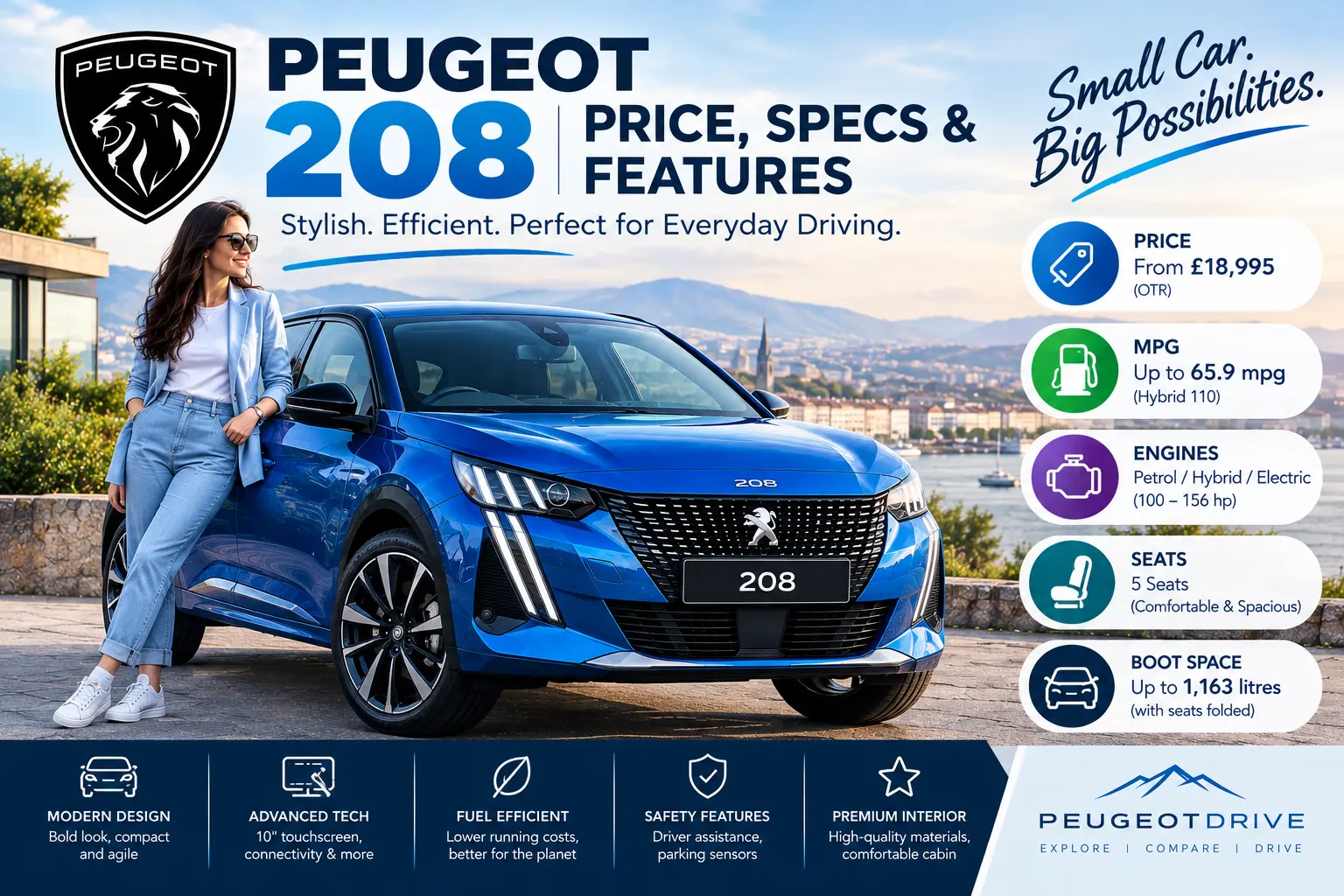
According to official Peugeot UK specifications, the Turbo 100 petrol model achieves 54.3–55.4 mpg, while the Hybrid 110 delivers 54.9–65.9 mpg. The Hybrid 145 offers 54.8–65.6 mpg, depending on specification.
However, official figures do not always match everyday driving conditions. Traffic, road speed, weather, tyre pressure and driving habits can all affect the results.
In this guide, we explain Peugeot 208 MPG, compare petrol and hybrid fuel economy, explore real-world consumption and share practical ways to reduce your running costs.
Peugeot 208 MPG at a Glance
The current Peugeot 208 range gives drivers several options for balancing performance and fuel efficiency. Here is a quick comparison of the main powertrains.
| Peugeot 208 version | Transmission | Official combined MPG |
|---|---|---|
| Turbo 100 petrol | 6-speed manual | 54.3–55.4 mpg |
| Hybrid 110 | 6-speed automatic | 54.9–65.9 mpg |
| Hybrid 145 | 6-speed automatic | 54.8–65.6 mpg |
| E-208 electric | Automatic electric drive | MPG not applicable |
Figures are published ranges and depend on the exact vehicle specification. Check the official figures for the model you intend to buy.
The E-208 uses electricity rather than petrol, so its efficiency is measured through electricity consumption and driving range instead of miles per gallon.
For petrol and hybrid versions, however, MPG remains a useful way to compare fuel efficiency.
What Is a Good MPG for the Peugeot 208?
For a small hatchback, an official combined fuel economy figure reaching the mid-60s is attractive. The Peugeot 208 Hybrid 110 currently offers the highest maximum figure among the powertrains compared here, reaching up to 65.9 mpg.
The Hybrid 145 follows closely at up to 65.6 mpg, while the Turbo 100 petrol reaches up to 55.4 mpg.
Nevertheless, these figures should be treated as a comparison guide rather than a promise of what you will achieve on every journey.
Peugeot uses the Worldwide Harmonised Light Vehicle Test Procedure (WLTP) to establish official fuel consumption figures. According to the UK Vehicle Certification Agency’s WLTP guide, the procedure provides standardised results that help buyers compare vehicles.
Your personal results may differ. For example, a driver who spends most of the week travelling through busy city streets may achieve different MPG from someone who regularly drives on motorways.
Peugeot 208 Petrol MPG
The Peugeot 208 Turbo 100 is the conventional petrol option in the current range. Peugeot lists its official combined fuel economy at 54.3–55.4 mpg, depending on specification.
This version is worth considering if you want a straightforward petrol hatchback with a manual gearbox. It also suits drivers who prefer traditional refuelling and do not want to think about charging a vehicle.
Why choose the petrol Peugeot 208?
The Turbo 100 may be the right choice if you:
- Want to keep the initial purchase price manageable.
- Prefer a six-speed manual gearbox.
- Do not have access to home charging.
- Regularly travel on longer journeys.
- Want conventional petrol refuelling.
- Drive a mixture of urban and rural roads.
The petrol model can also make financial sense for drivers who cover relatively few miles each year. Although a hybrid may offer better maximum MPG, the higher purchase price of a particular hybrid version could reduce the benefit of its fuel savings.
Therefore, compare the full ownership cost rather than choosing a car based on fuel economy alone.
Peugeot 208 Hybrid MPG
The Peugeot 208 Hybrid combines a petrol engine with electric assistance to improve efficiency. Unlike a plug-in hybrid, it does not need to be connected to a home charger or public charging point.
The current range includes two main hybrid power outputs: Hybrid 110 and Hybrid 145. Both use a six-speed automatic transmission.
Peugeot 208 Hybrid 110 MPG
The Hybrid 110 achieves an official combined fuel economy of 54.9–65.9 mpg. Peugeot also lists CO₂ emissions of 96–116 g/km, depending on the vehicle configuration.
The range of figures matters because specifications, wheels and tyres can affect the official result.
Consequently, check the exact version before comparing prices or calculating your expected fuel costs. The highest published MPG figure may not apply to every trim level.
For drivers who spend a lot of time in towns and cities, the Hybrid 110 is particularly appealing. Its automatic gearbox and electric assistance can make stop-start traffic easier to manage while helping to reduce petrol consumption.
Peugeot 208 Hybrid 145 MPG
The more powerful Hybrid 145 achieves official combined fuel economy of 54.8–65.6 mpg.
Interestingly, its maximum published MPG figure is close to that of the Hybrid 110. This means you can consider the more powerful model if performance matters to you, without automatically ruling out the possibility of good fuel economy.
However, the right choice depends on your budget, driving style and the exact specification. Compare the purchase price alongside the fuel figures before making a decision.
How does the Peugeot 208 Hybrid save fuel?
The 208 Hybrid uses a self-charging system. During suitable driving conditions, it can recover energy as the car slows down and use that energy to assist the petrol engine.
As a result, the petrol engine does not have to supply all the power in every situation.
Peugeot states that its hybrid system can reduce fuel consumption by up to 15% compared with an equivalent petrol engine. In town, the manufacturer quotes a potential reduction of up to 30% under its stated conditions.
These are manufacturer claims, so your own savings will depend on the route, traffic, weather and driving habits.
Peugeot 208 MPG in City Driving
City driving can be where the Peugeot 208 Hybrid shows its greatest potential advantage.
Urban journeys often involve frequent braking, low-speed driving, queues and repeated acceleration. These conditions give the hybrid system opportunities to recover energy and provide electric assistance.
Consequently, the petrol engine may use less fuel than it would under comparable conditions without hybrid assistance.
The Hybrid 110 could therefore be a sensible option for commuters who regularly travel through busy towns or cities.
Nevertheless, heavy acceleration and long periods of congestion can still affect fuel consumption. Your actual MPG will depend on the conditions you encounter every day.
Peugeot 208 MPG on Motorways
Motorway driving presents a different challenge. At higher speeds, aerodynamic resistance increases, and the car generally needs more energy to maintain its speed.
As a result, the fuel-saving advantage of a hybrid may be less noticeable than during low-speed urban driving.
That does not mean the Peugeot 208 Hybrid is unsuitable for long-distance journeys. Both hybrid versions can still be efficient choices, but you should not expect to achieve the highest published MPG figure on every motorway trip.
Tips for better motorway fuel economy
To improve Peugeot 208 MPG on longer journeys:
- Maintain a steady, sensible speed.
- Avoid unnecessary acceleration and braking.
- Use cruise control where appropriate.
- Check tyre pressures regularly.
- Remove unnecessary items from the boot.
- Take off roof equipment when it is not needed.
- Plan your route to avoid unnecessary detours.
Above all, smooth driving can help reduce fuel consumption over time.
Peugeot 208 Real-World MPG: What Can You Expect?
One of the most common questions buyers ask is how much fuel the Peugeot 208 actually uses in everyday conditions.
There is no single answer because two drivers can achieve different results in identical cars. For this reason, official MPG figures are best used as a comparison tool.
Several factors influence real-world Peugeot 208 fuel economy.
Driving style
Hard acceleration and late braking generally increase fuel consumption. Instead, build speed smoothly and anticipate traffic to avoid unnecessary changes in speed.
Speed
Higher speeds usually require more energy, particularly on motorways. Driving at a steady, sensible speed can help improve efficiency.
Traffic conditions
Repeated stopping and starting can increase fuel use in a conventional petrol car. The hybrid system can recover some energy during deceleration, although it cannot eliminate every loss.
Weather
Cold weather can affect engine efficiency and battery performance. Heating, air conditioning and other electrical systems can also influence consumption.
Vehicle load
A heavily loaded car requires more energy to accelerate. Therefore, remove unnecessary items from the boot before longer journeys.
Tyre pressure
Underinflated tyres increase rolling resistance and may reduce fuel economy. Check the recommended pressures in your owner’s manual or on the vehicle’s tyre-pressure label.
Air conditioning
Heating and cooling systems can affect efficiency, particularly during short journeys or extreme temperatures. Use them sensibly while keeping the cabin comfortable and safe.
The Vehicle Certification Agency’s fuel consumption guidance explains why official figures may differ from results in real driving conditions.
Therefore, use published MPG figures to compare similar models, then consider your own driving pattern when estimating running costs.
Peugeot 208 Hybrid vs Petrol MPG
For many buyers, the main question is whether the Hybrid 110 or Hybrid 145 is worth choosing over the Turbo 100 petrol.
The following table summarises the main differences.
| Feature | Turbo 100 | Hybrid 110 | Hybrid 145 |
|---|---|---|---|
| Power | 101 hp | 110 hp | 145 hp |
| Gearbox | 6-speed manual | 6-speed automatic | 6-speed automatic |
| Official combined MPG | 54.3–55.4 | 54.9–65.9 | 54.8–65.6 |
| External charging required | No | No | No |
| Main appeal | Conventional petrol driving | Efficiency and urban driving | More power with hybrid assistance |
Specifications and fuel economy can vary by version. Confirm the details for your chosen vehicle before purchase.
The Turbo 100 is worth considering if you prefer a manual gearbox and straightforward petrol ownership.
Meanwhile, the Hybrid 110 is attractive for drivers who want an automatic car with strong official fuel economy. The Hybrid 145 offers additional power while retaining the benefits of hybrid technology.
However, the cheapest model to run will depend on more than MPG. Purchase price, insurance, maintenance and annual mileage should all be part of your calculation.
Which Peugeot 208 Has the Best Fuel Economy?
Based on the official figures listed above, the Hybrid 110 has the highest maximum combined MPG at 65.9 mpg.
Here is a quick guide to choosing the right version.
- Best maximum official MPG: Hybrid 110.
- Best for drivers wanting more power: Hybrid 145.
- Best for conventional petrol ownership: Turbo 100.
- Best for driving without petrol: E-208.
Although the Hybrid 110 leads on maximum published MPG, it may not be the most economical purchase for every driver. Your annual mileage, typical journey length and budget should guide your decision.
Peugeot E-208: What About Electric Efficiency?
The Peugeot E-208 is fully electric, so traditional petrol MPG does not apply.
Instead, buyers should consider its electricity consumption, usable battery capacity, driving range, charging speed and the cost of charging at home or using public charging points.
If you can charge at home overnight, the E-208 may offer lower day-to-day energy costs than a petrol car. However, the actual saving depends on your electricity tariff, mileage and charging habits.
Public rapid charging can also cost more than charging at home, so it is worth comparing local tariffs before buying an electric vehicle.
If you are exploring electric alternatives, visit PeugeotDrive for more Peugeot ownership and model guides.
How to Improve Peugeot 208 Fuel Economy
Regardless of which petrol or hybrid version you own, your driving habits can make a difference. These simple steps can help you get more miles from each tank of fuel.
1. Drive smoothly
Avoid sudden acceleration whenever possible. Instead, build speed progressively and look ahead to anticipate changes in traffic.
2. Brake early
Gradually reducing speed is often more efficient than accelerating hard and braking at the last moment. In a hybrid, smoother deceleration may also give the system more opportunities to recover energy.
3. Maintain the correct tyre pressure
Check your tyre pressures regularly and follow Peugeot’s recommended settings. Underinflated tyres can increase rolling resistance and waste fuel.
4. Remove unnecessary weight
Do not carry heavy items that you no longer need. Although a single item may have little effect, unnecessary weight over many journeys can influence consumption.
5. Avoid excessive speed
Higher speeds generally require more energy. Therefore, maintaining a steady and sensible speed can improve motorway economy.
6. Anticipate traffic
Look ahead for traffic lights, junctions and queues. By adjusting your speed early, you can avoid repeated acceleration and braking.
7. Maintain your car properly
Follow the recommended service schedule and keep your tyres in good condition. Proper maintenance helps your car operate as intended.
8. Avoid unnecessary idling
If you are stationary for an extended period, unnecessary engine idling wastes fuel. Follow your vehicle’s instructions and local safety guidance.
Does the Peugeot 208 Hybrid Need Charging?
No. The Hybrid 110 and Hybrid 145 use a self-charging hybrid system, so you do not need to plug them into a wallbox or public charging station.
The battery receives energy during suitable driving conditions, including regenerative braking. The electric motor then assists the petrol engine when appropriate.
Consequently, you can use the hybrid much like a conventional petrol car. Simply refuel with petrol when necessary.
This is a major advantage for drivers who want some of the benefits of electrification but do not have access to home charging.
Remember, however, that a self-charging hybrid is different from a fully electric car. The E-208 requires external charging to replenish its battery.
Is Peugeot 208 Hybrid Fuel Economy Better Than the Petrol Model?
The official maximum combined MPG figures favour the hybrid models.
The Hybrid 110 reaches up to 65.9 mpg, while the Hybrid 145 reaches up to 65.6 mpg. By comparison, the Turbo 100 petrol achieves up to 55.4 mpg.
Nevertheless, better fuel economy does not automatically mean lower overall ownership costs.
Before choosing, consider:
- Purchase price and available finance.
- Insurance premiums.
- Annual mileage.
- Servicing and maintenance.
- The type of journeys you regularly make.
- Expected resale value.
For example, a driver who covers only a few thousand miles annually may take longer to recover a hybrid’s additional purchase cost through fuel savings.
On the other hand, someone who drives frequently in urban conditions may benefit more from the hybrid system.
Peugeot 208 MPG: Which Model Is Best for You?
The best Peugeot 208 for fuel economy depends on how you use your car.
For city drivers: The Hybrid 110 is a strong option because its automatic transmission and electric assistance suit stop-start traffic.
For mixed driving: Both hybrid versions deserve consideration. Choose the Hybrid 145 if you want additional performance.
For long-distance drivers: The Turbo 100 remains worth considering if you prefer a conventional petrol engine and manual gearbox. The hybrid models can also be suitable for longer journeys.
For drivers with home charging: The E-208 is worth investigating if you want to eliminate petrol use and can conveniently recharge at home.
Ultimately, compare the full cost of ownership rather than focusing only on the highest MPG figure.
Peugeot 208 Fuel Economy and Running Costs
Fuel consumption is an important part of car ownership, but it is not the only expense to consider.
Your overall running costs may include:
- Petrol or electricity.
- Insurance.
- Servicing and repairs.
- Tyres.
- Finance payments.
- Vehicle tax, where applicable.
- Depreciation.
- Parking and other travel expenses.
A car with better MPG is not necessarily cheaper to own if it costs significantly more to buy.
For example, a low-mileage driver may save too little on petrol to justify paying a large premium for a hybrid. Conversely, a driver covering many miles in busy urban conditions could find the efficiency benefits more valuable.
How to estimate your Peugeot 208 fuel costs
You can estimate your annual petrol spending with this simple calculation:
Annual fuel cost = annual miles ÷ actual MPG × price per gallon
For UK fuel prices quoted per litre, convert the gallon price carefully: one UK imperial gallon contains approximately 4.546 litres.
For example, if you drive 10,000 miles annually and your car averages 50 mpg, you will use approximately 200 imperial gallons of petrol over the year. Multiply that amount by the petrol price per gallon to estimate your annual fuel bill.
For a more accurate estimate, use the MPG you actually achieve rather than the highest official figure.
Peugeot 208 MPG vs Peugeot 2008 MPG
If you want more space and a higher driving position, the Peugeot 2008 is a natural alternative to the 208.
The 2008 is a larger SUV, so fuel economy can be lower depending on the powertrain and specification.
For example, Peugeot’s published figures list the 2008 Hybrid 145 at 51.3–62.4 mpg, compared with 54.8–65.6 mpg for the 208 Hybrid 145.
This comparison highlights the potential efficiency advantage of a smaller car. However, the 2008 offers a higher seating position and additional practicality that may be more important to some families.
Therefore, balance fuel economy against passenger space, luggage capacity and everyday usability before making your choice.
Peugeot 208 MPG: Pros and Cons
Pros
- Strong official fuel economy figures for the hybrid models.
- Hybrid 110 achieves up to 65.9 mpg.
- Hybrid 145 achieves up to 65.6 mpg.
- Self-charging hybrid system requires no external charging.
- Compact dimensions suit urban driving.
- Petrol, hybrid and fully electric options are available.
- Automatic transmission is available with the hybrid versions.
Cons
- Real-world MPG may be lower than official figures.
- The hybrid efficiency advantage can vary with driving conditions.
- Higher-specification models may cost more to buy.
- Fuel economy depends on speed, weather, load and driving style.
- The E-208 requires a different approach to measuring energy costs.
Final Verdict: Is the Peugeot 208 Fuel Efficient?
Yes, the Peugeot 208 offers competitive official fuel economy figures, particularly with its current hybrid powertrains.
The Hybrid 110 leads the models compared in this guide, with a maximum official combined figure of 65.9 mpg. The Hybrid 145 reaches up to 65.6 mpg, while the Turbo 100 petrol achieves up to 55.4 mpg.
However, these figures are intended for comparison and do not guarantee the MPG you will achieve on the road.
For better fuel economy, focus on smooth acceleration, sensible speeds, correct tyre pressures and regular maintenance. In addition, removing unnecessary weight and anticipating traffic can help reduce fuel consumption.
If you mainly drive in towns and cities, the Hybrid 110 is an attractive option. Drivers who want more power may prefer the Hybrid 145, while those who favour a conventional manual petrol car can consider the Turbo 100.
Finally, if you can charge at home and want to stop using petrol, the E-208 is worth exploring.
The best choice is the one that suits your driving habits, annual mileage and budget—not simply the model with the highest advertised MPG.
10 FAQs About Peugeot 208 MPG
1. What is the Peugeot 208 MPG?
The current Turbo 100 petrol model achieves official combined fuel economy of 54.3–55.4 mpg. The Hybrid 110 offers 54.9–65.9 mpg, while the Hybrid 145 achieves 54.8–65.6 mpg, depending on specification.
2. Which Peugeot 208 has the best MPG?
The Hybrid 110 has the highest maximum official combined MPG figure among the versions compared here, reaching up to 65.9 mpg.
3. Is the Peugeot 208 Hybrid fuel efficient?
Yes. The hybrid system combines a petrol engine with electric assistance and can achieve up to 65.9 mpg officially. Actual consumption depends on the model specification and driving conditions.
4. Does the Peugeot 208 Hybrid need to be plugged in?
No. The Hybrid 110 and Hybrid 145 recharge their batteries through the vehicle’s hybrid system and do not require an external charging cable.
5. What MPG does the Peugeot 208 Hybrid 145 get?
The official combined fuel economy range is 54.8–65.6 mpg, depending on the vehicle configuration.
6. What MPG does the Peugeot 208 Hybrid 110 get?
The Hybrid 110 is officially rated at 54.9–65.9 mpg combined, depending on specification.
7. Is Peugeot 208 MPG better in the city?
The hybrid version can be particularly efficient in urban driving because it can recover energy during deceleration and provide electric assistance at low speeds. Actual results depend on traffic and driving style.
8. Does motorway driving reduce Peugeot 208 MPG?
It can. Sustained high speeds generally require more energy, so motorway fuel consumption may differ from the maximum official combined MPG figure.
9. How can I improve Peugeot 208 fuel economy?
Drive smoothly, avoid unnecessary acceleration, maintain the correct tyre pressures, remove unnecessary weight and anticipate traffic. Regular servicing can also help maintain efficiency.
10. Is the Peugeot 208 more economical than the Peugeot 2008?
The 208 Hybrid 145 has a higher published maximum combined MPG figure than the 2008 Hybrid 145 in the comparison used here. However, the exact difference depends on vehicle specification and driving conditions.