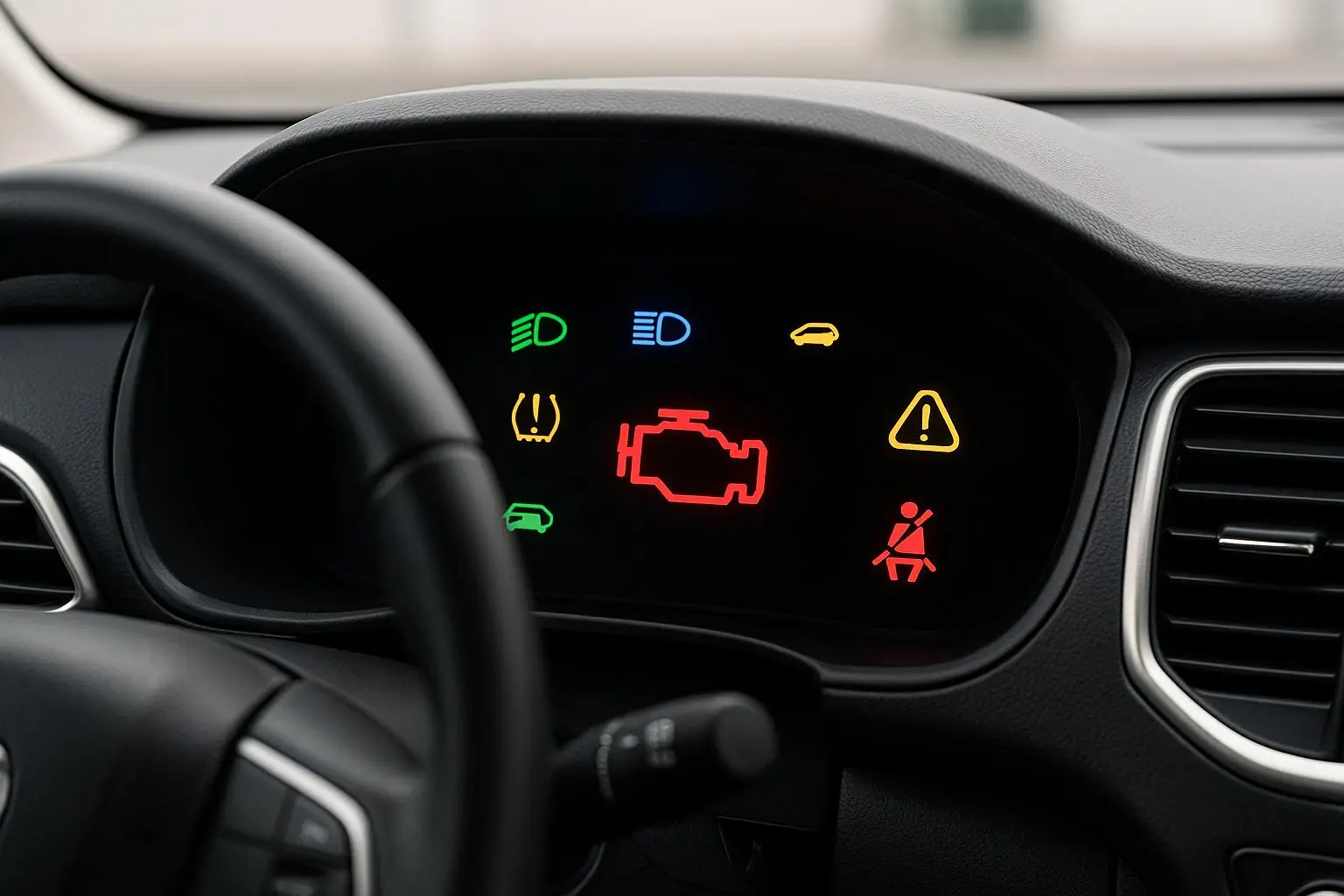
Seeing an unfamiliar symbol appear on your dashboard can be worrying, especially when you are driving and do not know whether it is safe to continue. Peugeot dashboard warning lights are designed to alert drivers to potential problems, maintenance requirements and the operating status of different vehicle systems.
However, not every warning means the same thing. A red STOP warning can indicate a serious fault, while an amber engine symbol may require a diagnostic check. Green and blue indicators usually show that a particular feature is active.
The meaning can also vary depending on your Peugeot model, engine, model year and equipment. This guide explains common Peugeot dashboard symbols, their possible causes, how urgent they are and what you should do when they appear.
What Do Peugeot Dashboard Warning Light Colours Mean?
Before identifying individual symbols, it is important to understand their colours. They provide an initial indication of how urgently you should respond.
| Warning light colour | General meaning | Recommended action |
|---|---|---|
| Red | Potentially serious fault | Stop safely if the warning requires it |
| Amber or orange | Fault or condition requiring attention | Investigate and arrange a check promptly |
| Green | A system or feature is operating | Usually informational |
| Blue | A lighting or other operating indicator | Usually informational |
| Flashing | Depends on the symbol and vehicle | Check the accompanying message immediately |
Red Peugeot Warning Lights
Red warnings deserve particular attention. They can indicate problems with the engine, oil pressure, cooling system, brakes or other safety-critical components.
For example, if the red oil pressure warning appears while driving, stop somewhere safe and switch off the engine. Continuing to run it could cause serious mechanical damage.
Amber or Orange Peugeot Warning Lights
Amber warnings generally indicate that a fault has been detected or a system needs attention.
The vehicle may still be driveable, depending on the symbol and symptoms. Nevertheless, do not ignore a persistent engine, ABS, airbag or emissions warning.
Green and Blue Dashboard Indicators
Green and blue indicators normally provide information rather than indicate a fault.
Examples include dipped headlights, indicators, fog lights and main beam headlights. Their exact meaning depends on the vehicle’s equipment.
Most Common Peugeot Dashboard Warning Lights and Their Meanings
Here are the important warning symbols Peugeot drivers should recognise.
1. Peugeot STOP Warning Light
The red STOP warning is one of the most serious alerts on a Peugeot dashboard.
It may appear alongside another warning symbol, an audible signal or a written dashboard message. Depending on the vehicle, it can indicate a serious engine, braking, steering, gearbox or electrical fault.
What should you do?
- Reduce speed carefully.
- Find a safe place to stop.
- Switch off the engine when instructed.
- Read the accompanying dashboard message.
- Contact Peugeot assistance or a qualified workshop.
Do not continue driving simply because the vehicle appears to be operating normally.
2. Peugeot Engine Management Warning Light
The engine-shaped symbol is commonly associated with the engine management or emissions-control system.
Possible causes include:
- Faulty sensors
- Ignition system problems
- Fuel delivery issues
- Emissions system faults
- Exhaust-related problems
- Air and fuel mixture issues
Can you drive with the engine warning light on?
If the light remains on and the vehicle feels normal, arrange a diagnostic inspection as soon as possible.
However, if it flashes or appears with severe vibration, overheating, unusual engine noise or significant power loss, stop safely and seek professional assistance. A flashing engine warning can indicate a fault that risks damaging the catalytic converter or other components.
3. Peugeot Oil Pressure Warning Light
The oil-can symbol indicates a potential problem with engine lubrication or oil pressure.
Possible causes include low oil level, an oil pump problem, restricted oil circulation or another lubrication-system fault.
What should you do?
Stop as soon as it is safe and switch off the engine. Check the oil level when appropriate and follow your vehicle handbook.
Remember that low oil pressure is not necessarily solved by adding more oil. If the warning remains, do not restart the engine unnecessarily. Arrange professional assistance.
4. Peugeot Coolant Temperature Warning Light
The thermometer symbol can indicate that the engine coolant temperature is too high.
Possible causes include:
- Low coolant level
- Cooling system leaks
- Faulty thermostat
- Cooling fan problems
- Water pump faults
What should you do?
Stop safely and allow the engine to cool. Never remove a hot coolant reservoir cap because pressurised coolant can cause serious burns.
Once the engine is completely cool, the coolant level can be checked according to the handbook. If the warning returns, arrange an inspection.
5. Peugeot Brake Warning Light
A red brake symbol can indicate that the parking brake is applied, brake fluid is low or the braking system has developed a fault.
First, check that the parking brake has been fully released.
If the warning remains, inspect the dashboard message and seek professional advice. If the brake pedal feels unusual or braking performance is reduced, stop driving and arrange recovery.
6. Peugeot ABS Warning Light
ABS means Anti-lock Braking System. This system helps prevent the wheels from locking during hard braking.
An illuminated ABS warning can indicate:
- Wheel-speed sensor problems
- Damaged wiring
- ABS control module faults
- Sensor contamination
- Other braking-system issues
The conventional braking system may continue to operate, but the anti-lock function may be unavailable.
Drive cautiously and arrange a diagnostic check. If the red brake warning also appears, treat the situation as more urgent.
7. Peugeot Airbag Warning Light
The airbag symbol indicates a potential fault with the supplementary restraint system.
The problem could involve airbags, seat-belt pretensioners, sensors, wiring or the restraint-system control unit.
Because these components protect occupants during an accident, an illuminated airbag warning should not be ignored.
Arrange a professional inspection and avoid attempting DIY repairs to airbag wiring or components.
8. Peugeot Battery Warning Light
The red battery symbol normally indicates a problem with the charging system rather than simply telling you that the battery is old.
Possible causes include:
- Alternator failure
- Weak or damaged battery
- Charging circuit problems
- Electrical wiring faults
- Drive belt problems on applicable engines
If the warning remains illuminated while driving, stop safely and seek assistance. The vehicle may eventually lose electrical power if the charging system is not functioning correctly.
9. Peugeot Tyre Pressure Warning Light
The tyre-shaped symbol with an exclamation mark indicates that the tyre pressure monitoring system has detected low pressure or a related fault.
Possible causes include a puncture, slow air leak, incorrect tyre pressure or a TPMS sensor issue.
Check all four tyres against the recommended pressures shown in your vehicle documentation or tyre-pressure label.
After correcting the pressure, reset the system only according to your Peugeot handbook. Do not reset the warning without checking the tyres first.
10. Peugeot SERVICE Warning Light
The amber SERVICE warning can be confusing because it does not always represent the same condition.
It may accompany a minor fault, a maintenance requirement or another warning symbol. The accompanying message is particularly important.
A routine service interval reminder is different from a SERVICE warning associated with a detected fault.
What should you do?
Read the message on the instrument panel and check whether another warning is illuminated. Arrange servicing or diagnostic work according to the message.
11. Peugeot AdBlue Warning Light
Diesel Peugeot models equipped with selective catalytic reduction (SCR) technology use AdBlue to reduce nitrogen oxide emissions.
An AdBlue warning can indicate that the fluid level is low or that the emissions-control system has detected a fault.
Depending on the vehicle, the dashboard may display a remaining-distance warning or a message indicating that the engine may not restart after a specified distance.
Use the correct AdBlue product and follow the handbook instructions when topping up. If the warning remains after refilling, professional diagnosis may be necessary.
12. Peugeot DPF Warning Light
The Diesel Particulate Filter (DPF) captures soot from diesel exhaust gases. It periodically removes accumulated soot through regeneration.
Frequent short journeys can prevent some diesel vehicles from completing regeneration successfully.
Possible symptoms include a DPF warning, reduced performance, increased fuel consumption and an engine management message.
Follow the regeneration instructions in your specific vehicle handbook. If the warning persists or the vehicle enters reduced-power mode, seek professional assistance rather than repeatedly attempting regeneration.
13. Peugeot ESP or Traction Control Warning Light
ESP stands for Electronic Stability Programme. Related Peugeot systems may also use terms such as DSC or ASR.
These systems help maintain stability and traction, particularly when accelerating or driving on slippery roads.
A light flashing briefly during acceleration or cornering may indicate that the system is actively controlling wheel slip.
However, if the warning stays illuminated, the system may have been switched off or detected a fault. Check your vehicle handbook and arrange a diagnostic inspection if necessary.
14. Peugeot Power Steering Warning Light
A steering wheel symbol can indicate a problem with the power-assisted steering system.
You might notice heavier steering, unusual resistance or difficulty turning the wheel.
If steering becomes unexpectedly heavy or unpredictable, stop somewhere safe and seek assistance. Do not continue a journey if you cannot control the vehicle confidently.
Peugeot Dashboard Warning Lights: Quick Reference Table
Use this table to identify some common warning symbols and understand their general urgency.
| Symbol or indicator | Possible meaning | General response |
|---|---|---|
| STOP | Serious vehicle fault | Stop safely |
| Engine symbol | Engine or emissions fault | Diagnose promptly |
| Oil can | Oil pressure problem | Stop and switch off |
| Thermometer | Engine overheating | Stop and allow to cool |
| Brake symbol | Parking brake or brake fault | Check immediately |
| ABS | Anti-lock braking fault | Drive cautiously and inspect |
| Airbag | Restraint system fault | Arrange inspection |
| Battery | Charging system fault | Stop safely and seek help |
| Tyre with ! | Low tyre pressure or TPMS fault | Check tyre pressures |
| SERVICE / spanner | Maintenance or detected fault | Read dashboard message |
| AdBlue | Low fluid or SCR fault | Follow vehicle instructions |
| DPF | Diesel filter warning | Follow handbook guidance |
| ESP / DSC | Stability control status or fault | Check system status |
| Steering wheel | Power steering fault | Stop if steering is affected |
These are general descriptions, not universal diagnoses. The exact symbol, colour, flashing behaviour and accompanying message must be considered together.
Why Are Multiple Peugeot Warning Lights Appearing at Once?
Sometimes several warning lights appear simultaneously, particularly after starting the vehicle.
This does not necessarily mean that every affected component has failed.
A weak 12-volt battery, charging-system problem or electrical communication fault can potentially trigger warnings across several systems.
For example, a battery-related issue may cause the ABS, ESP, engine management or other electronic systems to report faults.
However, never assume that a weak battery is responsible without proper testing.
A professional diagnostic scan, battery test and inspection of the charging system can help identify the underlying cause.
What Should You Do When a Peugeot Warning Light Appears?
Follow these practical steps when an unfamiliar symbol appears.
Step 1: Identify the Warning Colour
Check whether the warning is red, amber, green or blue. If it flashes, pay particular attention to the symbol and accompanying message.
Step 2: Read the Dashboard Message
Modern Peugeot vehicles often display additional information alongside the warning symbol.
Write down the exact message because it can help a technician identify the problem.
Step 3: Check the Vehicle’s Behaviour
Look for unusual noises, vibration, overheating, loss of power, heavy steering or changes in braking performance.
Step 4: Consult Your Peugeot Handbook
Warning lights can differ between the Peugeot 208, 2008, 3008, 5008, 308 and other models.
Always use the handbook for your exact vehicle and model year.
You can also access official vehicle documentation through Peugeot UK.
Step 5: Arrange Professional Diagnosis
If a warning persists, get the vehicle inspected. A diagnostic scanner can retrieve fault codes, but the codes must be interpreted and verified through appropriate testing.
Can You Drive With Peugeot Dashboard Warning Lights On?
Sometimes, but it depends on the warning.
An amber warning may allow you to drive cautiously to a workshop if the handbook permits it and the vehicle behaves normally.
On the other hand, an oil-pressure warning, serious overheating, major brake fault or red STOP warning may require you to stop immediately.
Do not rely on colour alone. Consider the symbol, message and symptoms together.
If you are uncertain whether the vehicle is safe to drive, stop somewhere safe and contact roadside assistance.
When Should You Stop Driving Your Peugeot Immediately?
Take particular care if you encounter:
- A red STOP warning with a serious fault message
- An engine oil pressure warning
- A serious coolant temperature warning
- Reduced braking performance
- Unexpectedly heavy steering
- Severe engine vibration or knocking
- A flashing engine warning accompanied by poor running
Find a safe place to stop, switch off the engine when instructed and arrange professional help.
Your safety and the condition of the vehicle should always come before completing the journey.
Related Peugeot Problems and Maintenance Guides
If you are troubleshooting a particular Peugeot, these guides can help you investigate related issues:
- Peugeot 208 Problems & Common Issues – Explore engine, battery, electrical, AdBlue and DPF concerns.
- Peugeot 2008 Problems and Reliability – Learn about common faults and ownership considerations.
- Peugeot PureTech Engine Problems – Understand timing-belt degradation, oil consumption and lubrication concerns.
- Peugeot Service Cost & Maintenance Guide – Learn about servicing, maintenance and preventative checks.
Final Thoughts: Do Not Ignore Peugeot Warning Lights
Peugeot dashboard warning lights provide important information about your vehicle’s condition. Some simply indicate that a feature is operating, while others can alert you to faults that require immediate attention.
The most important thing is to identify the symbol, understand its colour, read the accompanying message and consult your vehicle handbook.
Never ignore serious warnings involving oil pressure, overheating, brakes or steering. For less urgent warnings, arrange a diagnostic check before the problem becomes more expensive.
Remember that warning-light meanings can vary between models, engines and model years. Your Peugeot handbook and official manufacturer guidance should always take priority.
Frequently Asked Questions About Peugeot Dashboard Warning Lights
1. What do Peugeot dashboard warning lights mean?
Peugeot dashboard warning lights communicate information about vehicle systems, faults, maintenance requirements and operating conditions. Their meaning depends on the symbol, colour, vehicle model and accompanying message.
2. What does a red warning light mean on a Peugeot?
A red warning can indicate a serious problem. Depending on the symbol, you may need to stop safely, switch off the engine and contact roadside assistance or a qualified workshop.
3. Can I drive with an amber Peugeot warning light?
Some amber warnings allow cautious driving, but others require prompt attention. Check the vehicle handbook and accompanying message before deciding whether it is safe to continue.
4. What does the Peugeot STOP warning light mean?
The STOP warning can indicate a serious fault involving the engine, brakes, steering, gearbox or electrical systems. Stop as soon as it is safe when the warning requires it.
5. Why is my Peugeot engine warning light flashing?
A flashing engine warning can indicate a serious engine-management problem, including a misfire that may damage the catalytic converter. Reduce load, stop safely and seek professional advice, particularly if the engine is running roughly.
6. Why do several Peugeot warning lights appear together?
Multiple warnings can sometimes result from an underlying electrical problem, weak 12-volt battery, charging fault or communication issue. Proper diagnostic testing is needed to identify the cause.
7. What should I do if the Peugeot oil warning light comes on?
Stop safely and switch off the engine. Check the oil level when appropriate, but remember that an oil-pressure fault may have another cause. Do not continue driving if the warning remains.
8. Can Peugeot warning lights disappear automatically?
Some temporary warnings can disappear when the underlying condition is no longer detected. However, a warning that returns repeatedly or remains illuminated should be investigated.
9. Do all Peugeot models have the same dashboard warning symbols?
No. The symbols, colours, display positions and warning procedures can differ between models, engines, generations and equipment levels. Always consult the correct handbook.
10. How can I diagnose a Peugeot dashboard warning light?
Start by recording the exact symbol and dashboard message. Then check your vehicle handbook and arrange a diagnostic scan if necessary. A qualified technician should investigate the fault codes and verify the underlying cause before replacing components.